
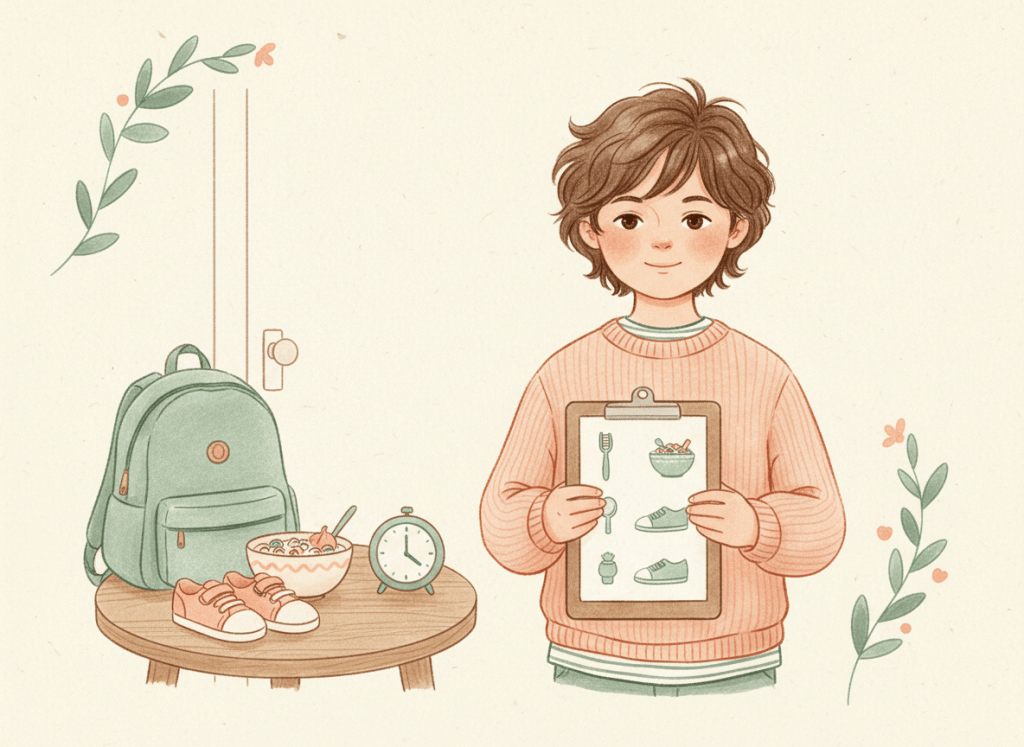
School mornings have a way of turning five ordinary tasks into a tiny household obstacle course. A missing shoe appears at the exact moment someone needs to leave. Breakfast takes longer than expected. A child who dressed independently yesterday suddenly cannot decide which shirt feels right today. The goal of a good morning routine is not to eliminate every surprise. It is to make the predictable parts of the morning predictable enough that everyone has more room for the surprises.
For children, a useful routine does more than keep the clock moving. Repeating a familiar sequence gives them opportunities to practice planning, remembering steps, shifting from one task to another, and doing more for themselves. Those abilities overlap with what researchers call executive function and self-regulation: skills used to focus attention, hold information in mind, make decisions, and follow a plan.
The best routine, then, is not the most elaborate one. It is the one your child can understand, your family can repeat, and everyone can recover from when the morning goes sideways.
Start the morning the night before
One of the easiest ways to improve a morning is to move decisions out of it. Anything that does not truly need to happen after waking can become an evening task: choosing clothes, finding shoes, packing a backpack, signing a school paper, filling a water bottle, or deciding what breakfast options will be available.
This is especially helpful because sleep is part of the morning routine even though it happens hours earlier. The CDC says children ages 6–12 generally need 9–12 hours of sleep in a 24-hour period, while teens ages 13–17 need 8–10 hours. The CDC also notes that adequate sleep supports focus, concentration, overall well-being, and academic performance. A routine that starts with a chronically overtired child is being asked to solve a problem it cannot solve by itself.
Instead of treating bedtime and morning as separate systems, connect them. A simple evening reset might be: backpack ready, clothes ready, shoes in their spot, then begin the bedtime routine. It does not need to look perfect. The win is waking up with fewer loose ends.
Build a short sequence before you build a detailed schedule
Adults often think in clock times: 7:00 wake up, 7:10 get dressed, 7:20 eat breakfast. Younger children may do better first learning the order of events. Think in a short chain: bathroom, get dressed, breakfast, teeth and hair, backpack and shoes.
That sequence becomes the backbone of the morning. Once it is familiar, you can attach times where they are genuinely useful. This keeps the routine from becoming a minute-by-minute performance review. If breakfast takes seven minutes one day and fourteen the next, the family can still move through the same sequence.
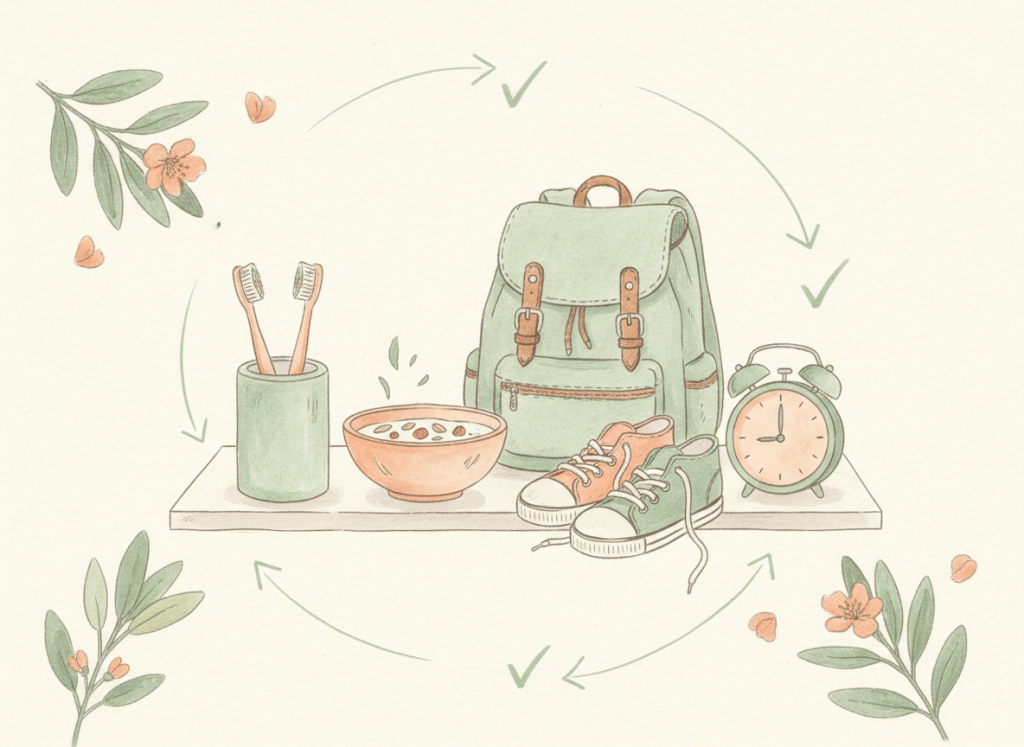
A visual checklist can make that order easier to remember. For a beginning reader, use pictures or simple icons with only a few words. For an older child, a written checklist may be enough. Keep it where the routine happens rather than tucked inside a binder nobody opens. A checklist by the bedroom door, bathroom mirror, or backpack station can act as an external reminder while a child is still learning to remember the sequence independently.
Give children real jobs, not pretend independence
Independence develops through practice. Harvard’s Center on the Developing Child describes executive function skills as abilities that help us plan, focus attention, switch gears, and manage information. The Center also emphasizes that children develop these skills through interactions and practice rather than simply being born knowing how to organize themselves.
That means a morning routine can become a small daily practice ground. A young child might put pajamas in a hamper, carry a breakfast dish to the sink, and put on shoes. An older elementary child might dress, brush teeth, fill a water bottle, check a backpack, and report that the list is complete. A preteen might be responsible for an alarm, breakfast, lunch check, and leaving with everything needed.
The important part is choosing jobs the child can actually learn. If an adult silently completes every task because it is faster, the morning may run smoothly today but the child gets no practice. On the other hand, handing over ten unfamiliar responsibilities at once can create frustration. Add independence one piece at a time.
Use fewer reminders—and make them more useful
Repeated verbal reminders can become background noise: get dressed, brush your teeth, find your shoes, grab your backpack. Try replacing some of that narration with one consistent prompt such as, “What comes next on your list?” The question points the child back toward the system instead of making the adult the system.
For a child who loses track easily, make the next step obvious. Put the backpack in one home base. Keep shoes in one predictable place. Place the toothbrush where it is easy to see. Reduce the amount of searching and remembering required before the child can begin the task.
Simple choices can also help when a child gets stuck. The CDC’s developmental guidance for young children recommends offering a small number of healthy choices rather than an unlimited field of options. The same principle is useful on busy mornings: “blue shirt or green shirt?” is easier to act on than “what do you want to wear?”
Protect a little margin
A routine scheduled to use every available minute is fragile. Someone spills milk and the whole system is suddenly late. If possible, aim to be ready several minutes before the true departure deadline. That margin can absorb the ordinary unpredictability of family life.
Margin is useful emotionally, too. A child who finishes early can read, draw, talk, or help with a final task instead of hearing increasingly urgent countdowns. If extra time reliably turns into a battle over screens, choose a small menu of calm “ready early” activities in advance.
Make movement part of the bigger picture
Morning movement does not have to mean a formal workout. A walk to school, a short walk with the dog, stretching while breakfast is being finished, or a few minutes outside can be a pleasant transition into the day when your schedule allows it. The CDC recommends that children and adolescents ages 6–17 get at least 60 minutes of moderate-to-vigorous physical activity each day. The morning can contribute a little to that total without becoming another box everyone must anxiously check.
What to do when the routine stops working
Even a good routine will fail sometimes. Before adding consequences or more reminders, look for the point where the system is breaking.
- Always searching for something? Give that item a permanent home.
- Getting dressed takes forever? Choose clothes the night before or reduce morning choices.
- Breakfast creates a bottleneck? Offer two or three dependable options on school days.
- Your child forgets the sequence? Shorten the checklist and make it more visible.
- Everyone is exhausted? Look at bedtime, sleep duration, and the evening routine before demanding more speed in the morning.
- One transition causes repeated conflict? Practice that step at a calm time instead of teaching it during the morning rush.
Also remember that children are not machines. Development, temperament, disability, sensory needs, sleep, illness, and changes at school can all affect how independently a child moves through a routine. The routine should support the child in front of you, not an imaginary child who always responds the same way.
Try a one-week reset
If mornings currently feel chaotic, resist the urge to redesign everything tonight. Pick one week and make three changes: move two tasks to the night before, write or draw a five-step morning sequence, and choose one task your child will practice doing independently.
For the first few days, teach the routine instead of merely announcing it. Walk through the sequence, point to the checklist, and show where important items live. Near the end of the week, step back a little. Notice which steps your child starts without help and where the routine still needs support.
Success does not have to mean silence, perfect punctuality, or a child who never needs a reminder. A more useful outcome is that everyone knows what happens next, fewer tasks depend entirely on one adult’s memory, and your child gradually owns more of the process.
A calmer morning is a practiced morning
The most dependable family routines are usually simple enough to survive real life. Prepare what you can ahead of time. Keep the sequence short. Make expectations visible. Protect sleep. Give children meaningful responsibility and enough practice to grow into it. Then adjust the routine when your family changes.
You may still have mornings when someone cannot find a shoe. The difference is that one missing shoe no longer has to carry the entire morning on its tiny, inconvenient shoulders.
Sources & Further Reading
- CDC — About Sleep
- CDC — Sleep and Health for Students
- Harvard Center on the Developing Child — A Guide to Executive Function
- Harvard Center on the Developing Child — Activities to Practice Executive Function Skills
- CDC — Physical Activity Guidelines for Children
Find Pencil & Pebble
Etsy Store · Coming soon | Teachers Pay Teachers Store · Coming soon | YouTube · Coming soon | Instagram · Coming soon | Pinterest · Coming soon

