
By Paige Turner
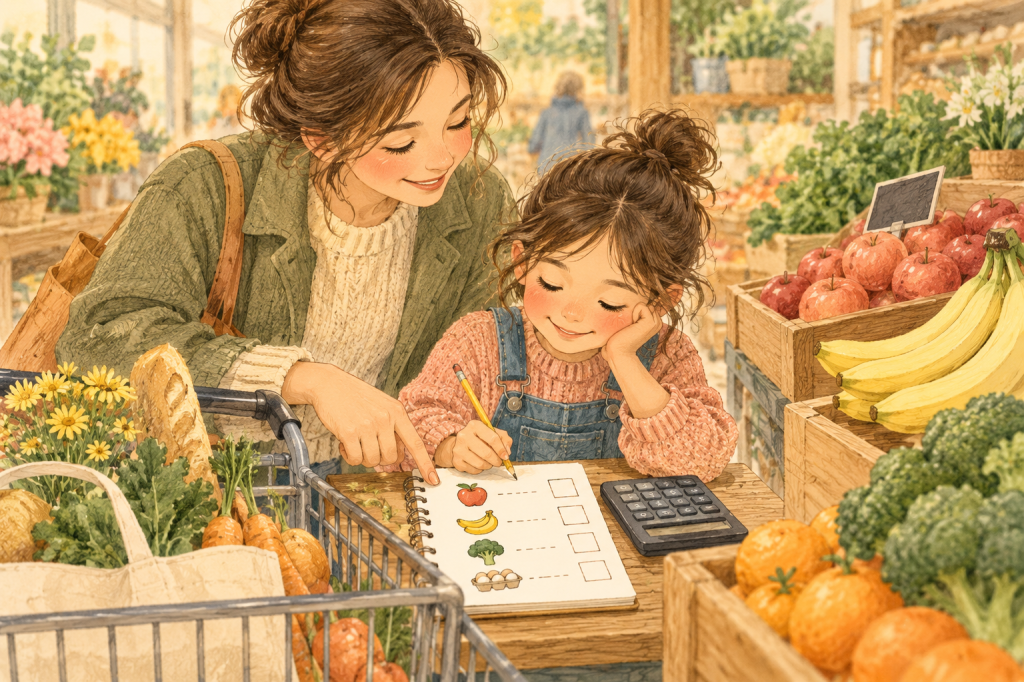
The grocery store is full of mathematics children can see, touch, and use. There are quantities to count, prices to compare, weights to estimate, shapes to notice, and choices to make within a budget. Yet a useful grocery-store math lesson does not need to turn an already busy errand into a quiz.
The goal is much smaller: invite your child into one real decision.
That might mean counting four apples, choosing the better buy between two sizes, estimating whether the cart will stay under a simple budget, or checking whether a package contains enough servings. When the question belongs to an actual family task, the math has a reason to exist.
Start With One Job, Not a Worksheet
Children usually learn more when they can follow one clear responsibility from beginning to end. Before entering the store, choose a job that fits your child and the amount of time you have.
A younger child might be the quantity checker. Their job is to make sure the cart gets six bananas, two cans, and one loaf of bread. A child practicing addition might be the running-total helper, adding rounded prices for three or four items. An older elementary child can be the comparison shopper, checking unit prices or deciding which package meets a budget.
Keep the job stable for the trip. If you ask a child to count, estimate, compare, read labels, calculate change, and explain every answer, the experience stops feeling authentic. One job provides enough repetition to notice a strategy without exhausting everyone.
Math Ideas by Age and Readiness
Age ranges are only starting points. Use the version that lets your child think without being buried in calculation.
Preschool and kindergarten: count, match, and describe
- Count a requested number of loose fruits or vegetables.
- Match items in the cart to simple picture or word list entries.
- Compare packages using words such as heavier, lighter, taller, shorter, more, and fewer.
- Find familiar shapes on boxes, cans, labels, and produce.
- Sort items at home by where they will be stored: pantry, refrigerator, or freezer.
The adult can model precise language naturally: “This bag feels heavier, but it has more oranges inside.” That connects a comparison word to a visible reason.
Grades 1 and 2: add, subtract, and estimate
- Count by twos or fives when selecting multiples.
- Round a price to the nearest dollar before adding it to a running total.
- Find how many more items are needed: “We need eight yogurts and have five. How many are missing?”
- Compare two prices and find the difference.
- Predict whether a group of items will cost more or less than a small target amount.
If the exact cents make the arithmetic too demanding, cover them for the first estimate. A carton marked $3.79 can become “about four dollars.” Estimation is not inaccurate arithmetic; it is a useful way to judge whether an answer is reasonable.
Grades 3 through 5: unit price, multiplication, and budgets
- Compare the cost per ounce or per item using the unit-price shelf label.
- Calculate the price of several identical items.
- Work within a small category budget, such as choosing fruit for less than $10.
- Compare a sale price with the original price.
- Use serving information to decide how many packages a family needs.
- Estimate the total first, then compare it with the receipt.
Unit price deserves explanation because the lowest package price is not always the lowest cost for the amount received. Point to both labels: “This is what the package costs. This smaller number tells what one ounce costs.” Then ask what your family actually needs. A larger package is not a bargain if food will be wasted or the purchase does not fit the budget.
Five Grocery Challenges That Stay Manageable
1. The $10 produce plan
Give an older child a firm amount and a real goal: choose two or three fruits for snacks without going over $10. Let the child round prices, record a running estimate, and adjust if necessary. At checkout, compare the estimate with the actual total.
2. Same food, different size
Choose two sizes of the same item. Ask three separate questions:
- Which package costs less today?
- Which has the lower unit price?
- Which one makes sense for our family?
That third question matters. Mathematics helps with decisions, but it does not make the decision by itself.
3. Find the missing amount
Use a short list with target quantities. If the cart contains three cans and the list calls for five, ask what is missing. Children can solve with fingers, a quick drawing, counting on, or subtraction. Accept any understandable strategy before naming a more efficient one.
4. Estimate the basket
Select five items and round each price to the nearest dollar. Add the rounded numbers before checkout. Afterward, look at the receipt and discuss whether the estimate was high, low, or close. Ask what caused the difference rather than treating closeness as a grade.
5. Receipt detective
At home, give the child a short mission: find the most expensive item, circle two items that cost nearly the same, or choose three items whose total is close to $10. A receipt is dense, so cover unrelated lines with a sheet of paper if needed.
Let Children Show Their Own Strategies
When adults know a quick method, it is tempting to demonstrate it immediately. First ask, “How could we figure that out?” A child might count up, group equal items, draw tally marks, use repeated addition, or round prices. These approaches reveal what the child understands.
If a strategy becomes cumbersome, connect it to a more efficient one. “You added three dollars four times. That is the same as four groups of three, so we can write 4 × 3.” The formal notation now describes thinking the child already did.
Avoid correcting in the middle of a crowded aisle unless the answer affects the purchase. You can say, “Let’s save that one for the receipt at home.” Real-life math should feel useful, not public.
Make the Experience Accessible
Grocery stores can be noisy, bright, unpredictable, and rushed. A child who can solve a problem comfortably at home may not be able to do it beside a busy checkout line. That is not proof that the child lacks the skill.
Try one of these adjustments:
- Preview the job before leaving home.
- Use a picture list or a note card with only the relevant items.
- Do the thinking in a quiet corner or in the car after shopping.
- Let the child point, use a calculator, or dictate instead of writing.
- Take a photograph of two shelf labels and compare them later.
- Skip the activity when the store is unusually busy.
A calculator is appropriate when calculation is not the learning target. If the goal is comparing unit prices or staying within a budget, offloading long arithmetic may allow the child to focus on the decision.
A Simple Ten-Minute Version
You do not need to plan the whole trip around learning. Try this short sequence:
- Before entering, name one job.
- In the store, complete two examples.
- Ask the child to explain one choice.
- At home, check one result on the receipt.
- End without adding another assignment.
Over several trips, rotate the job. Counting can become estimating; estimating can become budgeting. The repeated setting helps children recognize that the same mathematical ideas work in many situations.
What Children Are Really Learning
Grocery-store math builds more than computation. Children practice attending to information, choosing what matters, estimating before calculating, checking whether an answer is reasonable, and revising a plan when the numbers do not work. They also see adults use mathematics to make ordinary decisions.
That is the lasting lesson: math is not confined to a page. It is a tool families use to notice, compare, plan, and choose.
Sources & Further Reading
- USDA Team Nutrition: MyPlate Resources
- USDA MyPlate Grocery Store Bingo
- What Works Clearinghouse: Assisting Students Struggling with Mathematics

