
By Paige Turner
A shadow can look so ordinary that we stop noticing it. Set the same object in one sunny place, trace its shadow several times, and that ordinary shape becomes evidence. Children can watch the shadow move, compare its length, make predictions, and use what they see to reason about the Sun’s apparent path across the sky.
This investigation works well in early fall because the weather may still allow outdoor observation while the Sun’s position is changing noticeably. It can be completed in one day, revisited over a week, or simplified to two observations.
What You Need
- a sunny outdoor spot that will remain undisturbed;
- sidewalk chalk or a large sheet of paper taped securely to the ground;
- a pencil, craft stick, or dowel that can stand upright;
- modeling clay or a container of packed soil to hold it;
- a ruler or measuring tape;
- a watch or clock; and
- a notebook or observation page.
Choose a location away from moving vehicles and heavy foot traffic. Remind children never to stare at the Sun. The shadow provides all the evidence needed.
Set Up a Fair Test
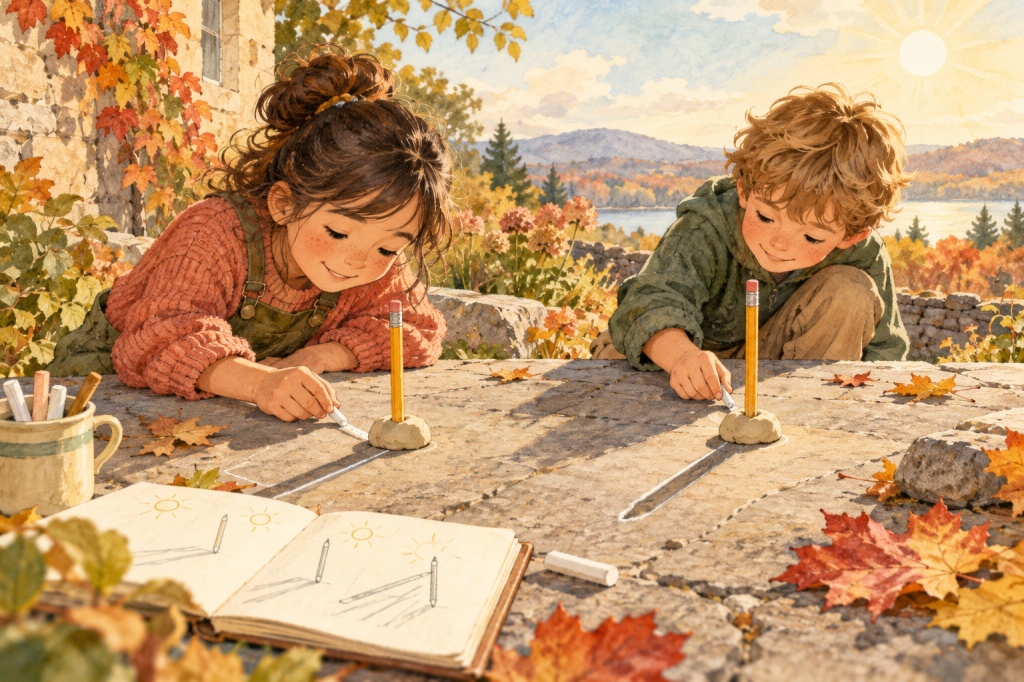
Place the clay on a level surface and push the pencil into it so the pencil stands as straight as possible. Trace around the base so it can be returned to the same position if bumped. Mark one side of the setup as “do not move.”
The object and location should stay the same. Time will be the main thing that changes. This is a useful opportunity to introduce the idea of a fair comparison without turning the activity into a lecture.
Ask before the first tracing:
- Where do you think the shadow will point?
- Will it be longer or shorter later?
- Do you think it will move in the same direction as the Sun appears to move?
- What should we keep the same each time?
Record predictions as words, drawings, or dictated sentences. A prediction is not a promise to be correct. It is a starting idea that the evidence can support or change.
Make the First Observation
Trace the entire shadow, including the tip. Write the time beside it. Measure from the base of the pencil to the shadow’s tip and record the length. Children can also note:
- the direction the shadow points;
- whether its edges look sharp or fuzzy;
- cloud cover;
- the weather; and
- anything that may affect the observation.
Young children can use a simple drawing and one comparison word. Older children can make a table with columns for time, length, direction, and notes.
Return at Useful Intervals
Three observations are enough to reveal change: morning, near midday, and afternoon. If that is not practical, trace once early and once later. More observations create a richer pattern, but only if the family or class can return consistently.
At each visit:
- Confirm that the object has not moved.
- Trace the new shadow in a different chalk color.
- Label the time.
- Measure the length.
- Compare it with the previous tracing.
Invite children to notice before explaining. “What changed?” should come before “Why?” Observations might include that the shadow’s tip shifted, the afternoon shadow points in a different direction, or the shortest tracing occurred around the middle of the observation period.
Help Children Build an Explanation
Earth rotates, which makes the Sun appear to move across our sky. As the apparent position of the Sun changes, the direction and length of an object’s shadow change. When the Sun is lower in the sky, shadows are generally longer. When it is higher, shadows are shorter.
Use a flashlight and a small object indoors to model this relationship. Keep the object still. Hold the flashlight low and notice the long shadow; raise the light and notice the shorter shadow. Move the light from one side to the other and watch the shadow point away from it.
Ask children to connect the model to the outdoor evidence:
- Which flashlight position is most like our morning observation?
- What position produced the shortest shadow?
- Why does the shadow point away from the light?
- What does the model explain well, and what is different outdoors?
The flashlight does not need to reproduce the exact sky. Its purpose is to make one relationship easier to see.
Adjust the Investigation by Age
Preschool and kindergarten
Focus on tracing, comparing, and directional words. Ask whether the new shadow is longer, shorter, or about the same. Let the child stand in the same place and trace a body shadow with adult help.
Grades 1 and 2
Measure to the nearest whole inch or centimeter. Put the lengths in order and create a simple bar graph. Ask children to draw the setup at two times.
Grades 3 through 5
Measure at regular intervals, calculate differences in length, create a line graph, and write a claim supported by at least two observations. Older students can repeat the investigation a week or month later and compare patterns.
Common Problems Are Part of the Science
Clouds may block the shadow. Chalk may wash away. The pencil may be bumped. Treat these as conditions to document, not reasons to declare the activity ruined.
If the object moves, reset it using the traced base and note the interruption. If clouds appear, record “no clear shadow” at that time. If tracing on paper, photograph the setup before bringing it inside. Scientists work with imperfect conditions and explain how those conditions affect their evidence.
Extend the Learning
Make a human shadow sequence
Have one child stand on the same marked footprints at two or three times. Trace or photograph the shadow from the same camera position.
Compare objects
After completing the fair test, compare a tall object and a short object at the same time. Which makes the longer shadow? Does shape affect the outline?
Create shadow art
Arrange leaves, blocks, or small toys and trace the combined shadow. Return later and decide how the arrangement must change to fit the original outline again.
Build a simple time marker
Use the labeled tracings to estimate when a familiar part of the day has arrived. Explain that this is a local observation tool, not a precise modern clock.
Ask a seasonal question
Repeat the measurement from the same place later in the year. Keep the object, observation time, and setup consistent. Compare the shadow lengths and generate questions about seasonal Sun angles.
What to Put on an Observation Page
A useful page needs room to think, not just tiny blanks. Include:
- date and location;
- a weather box;
- prediction space;
- a table for time and length;
- a large area for a diagram;
- “I notice…” and “I wonder…” prompts; and
- a final claim with evidence.
Children who are not ready to write complete sentences can dictate, label a drawing, or use comparison symbols. The science is in the careful noticing and reasoning, not the amount of handwriting.
A Natural Conclusion
At the end, return to the original predictions. Avoid sorting them into right and wrong. Ask what evidence changed or strengthened each idea. A child who revises a prediction has done something important: used observations to update a model of how the world works.
One pencil, a patch of sunlight, and a few chalk lines can hold an entire investigation. The result is not merely a pretty pattern on the ground. It is a visible record of change that children helped collect themselves.

