
By Paige Turner
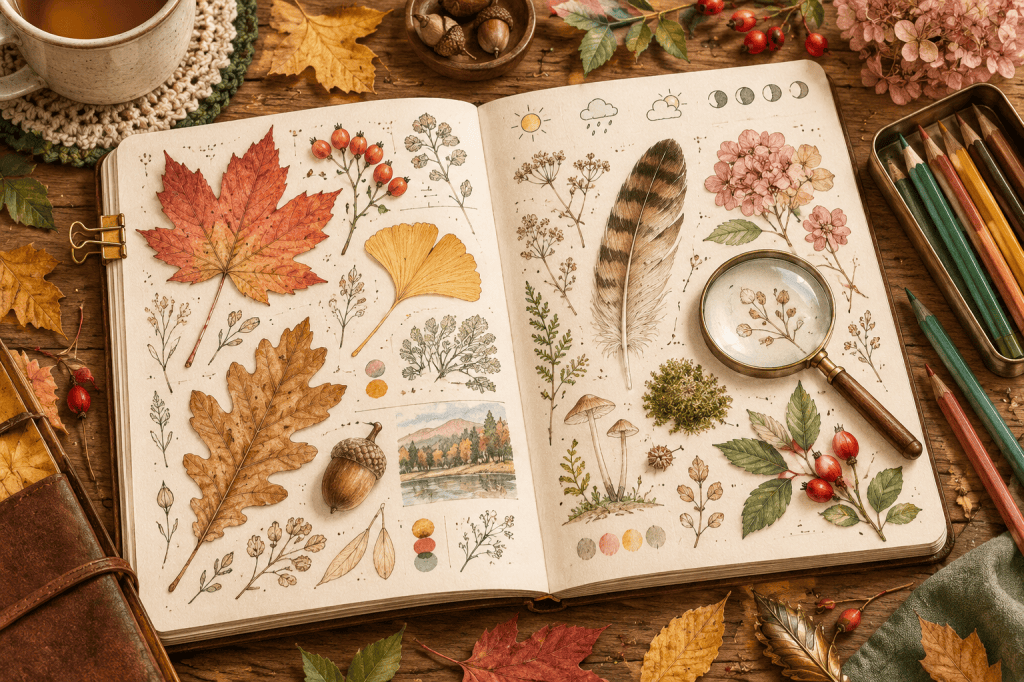
October offers visible change: cooler mornings, shifting daylight, seed pods, migrating birds, changing leaves, new shadows, and different sounds. An observation journal helps children slow down long enough to notice those changes. It can support science, drawing, vocabulary, measurement, and writing, but it should not require a polished paragraph every time it is opened.
The most useful journal is spacious, repeatable, and flexible enough for different ages. Its job is to hold evidence and questions, not to make every outdoor moment look like an assignment.
Decide What the Journal Is For
Before designing or printing pages, choose a clear purpose. A journal might document:
- one tree across the month;
- daily or weekly weather;
- objects collected on walks;
- birds, insects, or neighborhood animals;
- changes in daylight and shadows;
- a garden or windowsill plant; or
- any interesting thing noticed outdoors.
A narrow focus makes comparison easier. An open journal encourages curiosity. Both are valid, but they create different pages. If you are unsure, use an open observation page plus one repeated monthly study, such as the same tree every Friday.
Build the Core Page Around Observation
A strong page can include six elements:
- Date, time, and place. Time and location make later comparisons meaningful.
- Weather. Use words, symbols, or a quick temperature reading.
- A large drawing area. Make this the biggest part of the page.
- I notice. Record details that can be observed.
- I wonder. Capture questions without requiring answers.
- One measure or comparison. Length, number, color, sound, texture, or change since last time.
Avoid squeezing all six into tiny decorative boxes. Children need room to draw the branching pattern of a leaf, label parts, or revise a shape. A clean half-page drawing area is often more useful than multiple narrow lines.
Teach the Difference Between Noticing and Explaining
Young observers often jump from evidence to explanation: “The leaf is brown because it is dead.” Help them separate the two without shutting down the idea.
Try:
- I notice: “The edges are brown and curled.”
- I think: “It may be drying out.”
- I wonder: “Did it change after the cold night?”
All three statements matter, but they do different work. Modeling this distinction supports later scientific reasoning. Children learn that an explanation should connect to what was actually observed.
Drawing Counts as Serious Recording
Drawing encourages children to look again. Ask them to draw what is present rather than what a generic leaf, bird, or cloud “should” look like.
Useful prompts include:
- Where is the widest part?
- What do the edges do?
- How many main lines or parts can you count?
- Which colors are really there?
- What is in front, behind, or underneath?
- Can you add a size reference?
Labels can be single words. A child may dictate a sentence to an adult, use arrows, add numbers, or circle a changing area. None of these options is a lesser journal entry.
Create Three Levels of Support
One printable can work across several ages if it offers choices.
Emerging observers
Provide weather icons, a large blank space, and two oral prompts: “What do you see?” and “What changed?” The adult can write one dictated sentence.
Developing writers
Include sentence starters such as “I notice…,” “I wonder…,” and “Compared with last time….” Leave enough room for a drawing and two or three sentences.
Independent observers
Use an open field notebook format with optional data boxes for time, temperature, measurements, and a claim supported by evidence.
Do not label the versions by grade on the child’s page. Choose the amount of structure that helps the learner work independently.
Add Repeated Pages That Reveal Change
A single observation is valuable. Repeated observations reveal patterns. Include at least one page designed for return visits.
Same spot, four times
Divide a two-page spread into four generous panels. Visit the same outdoor spot weekly and draw the same view. Record one thing that appeared, disappeared, or changed.
October color record
Create a small color swatch each week based on objects actually observed. Children can blend colored pencils to match a leaf rather than choosing a symbolic “fall orange.”
Shadow check
Observe the shadow of the same fixed object at the same clock time on different dates. Sketch direction and length. Note that weather may prevent some entries.
Sound map
Draw the observer in the center of a page. Add symbols around the page to show where sounds came from and whether they were near, far, natural, or human-made.
Keep Collection Responsible
The journal does not require children to remove living things. Photographs, rubbings of sturdy fallen objects, sketches, and written descriptions often preserve more information than a bag of specimens.
Set simple boundaries:
- collect only fallen, common objects where collection is allowed;
- leave nests, living plants, fungi, and animals in place;
- wash hands after handling outdoor materials;
- do not taste unknown plants or berries; and
- follow park, school, and property rules.
If an object is brought indoors, tape in a small safe sample only if it will not crumble or mold. A drawing or photograph may be the better record.
Use the Journal Without Overcorrecting It
An observation journal is working when a child is noticing more carefully. Spelling, handwriting, and artistic realism do not need simultaneous correction.
Respond to content first: “You drew the tiny holes near the edge. I missed those.” Ask one question that sends the child back to the object. If a scientific word would help, offer it after the observation: “Those lines carrying water through the leaf are called veins.”
Avoid supplying a long list of facts before children look. Background information is valuable, but observation should have room to lead.
A Manageable October Rhythm
Try one substantial entry and one tiny entry each week.
- Monday: two-minute weather mark.
- Wednesday: sketch one found object.
- Friday: revisit the month-long study.
- Weekend: optional family walk or photo entry.
This rhythm creates continuity without making the journal a daily burden. If a week is busy, one dated drawing is still a valid record.
Finish With a Month-End Look Back
At the end of October, spread out the pages. Ask:
- What changed most?
- What stayed surprisingly similar?
- Which entry contains the most useful detail?
- Which question could we investigate next?
- What did you begin noticing that you had ignored before?
Children can choose one page to annotate with a later thought. This shows that records are not frozen; new observations can change what we think earlier evidence means.
Turn One Entry Into a Small Investigation
When a question keeps returning, use it to plan a simple follow-up. If a child wonders why one side of the tree has more colored leaves, photograph both sides at the same time of day, note sunlight and wind exposure, and revisit the comparison. If mushrooms appear after rain, record location and weather without touching or identifying them by guesswork. If bird activity changes, count sightings during the same five-minute window on several mornings.
Keep the plan narrow: one question, one kind of evidence, and two or three observations. Write what would count as a useful comparison before collecting more information. The result may not answer the question completely. A journal can end with a better question, and that is a worthwhile outcome.
Store Pages So Children Can Compare Them
Loose pages disappear easily. Use a thin binder, clipboard folder, stapled booklet, or photo album with page sleeves. Keep the journal near the door with pencils and a small ruler so starting does not require a search for supplies. If the journal travels outdoors, place pages on a firm board and carry only the tools needed that day.
Digital photographs can supplement the journal, but they should not replace looking. Print a few small images or let the child choose one photograph to sketch later. Drawing after taking a photograph can reveal details that were missed in the moment.
The finished journal may be uneven. Some pages will be detailed and others nearly empty. That is normal. Its value lies in the trail of attention it creates: a child looked, recorded, returned, and noticed the world changing.
Sources & Further Reading
- Smithsonian Education: Introduction to the Nature Journal
- Smithsonian Education: Educator Publications
- National Science Teaching Association

