
By Paige Turner
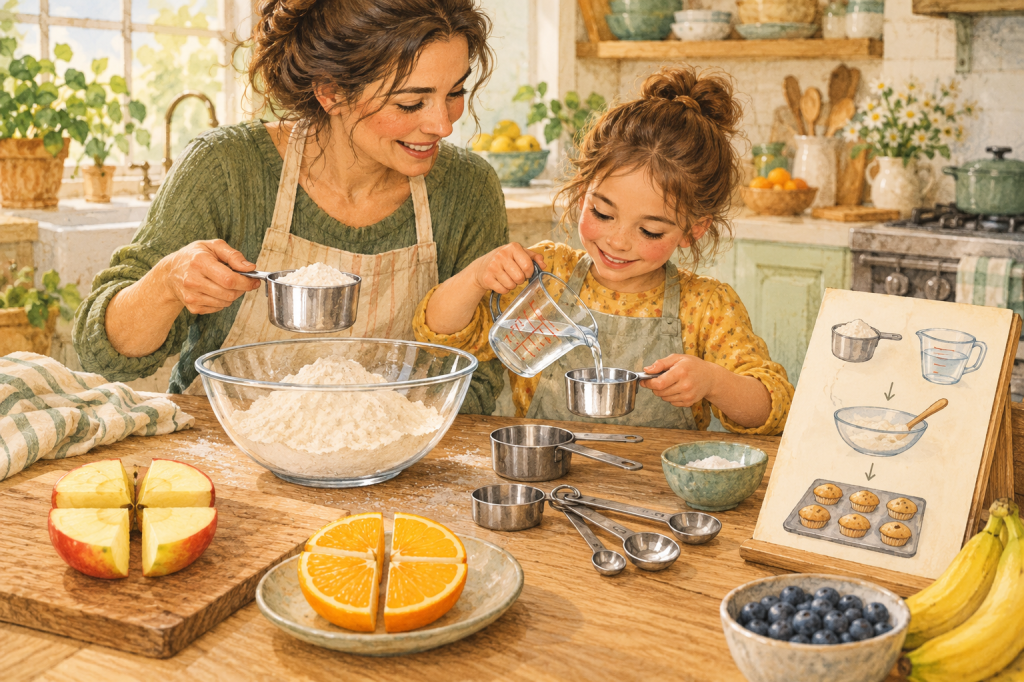
Cooking gives fractions a job. One-half cup fills a real bowl. Two quarter-cups can be combined and compared with one half-cup. A whole apple can be divided, rearranged, and shared. These experiences help children connect fraction symbols to quantities.
The kitchen is not automatically a math lesson, though. If an adult measures everything while a child watches, the fractions remain labels. Choose one idea, slow down for it, and let the child handle safe tools.
Begin With the Whole
A fraction only makes sense in relation to a whole. Name the whole each time:
- one whole cup;
- one whole apple;
- one full pan;
- one batch of muffins; or
- one length of dough.
Ask, “What is the whole in this problem?” Two pieces can represent one-half only if the whole has been divided into two equal parts. Unequal pieces are still pieces, but they are not halves.
Explore Measuring Cups Before Cooking
Set out 1 cup, 1/2 cup, 1/3 cup, and 1/4 cup measures. Let children order them by predicted capacity. The cup heights may be misleading, so test with water or dry rice over a tray.
Useful investigations include:
- How many half-cups fill one cup?
- How many quarter-cups fill one cup?
- Does two-thirds fill the same amount as two one-third cups?
- Which is larger, one-third or one-fourth?
- Can three different combinations make one cup?
Children should pour and count. Record equations after the relationship is visible: 1/2 + 1/2 = 1 and 1/4 + 1/4 = 1/2.
Use Equal-Part Foods Carefully
Choose foods that can be divided clearly, such as tortillas, sandwiches, apples, oranges, or a rectangular piece of dough. An adult handles sharp knives.
Compare one whole cut in different ways. Two halves and four fourths can cover the same plate area when reassembled. Emphasize that more pieces do not mean more food. The size of each piece changes as the number of equal parts changes.
Ask children to prove equivalence by matching or covering, not merely repeating a rule.
Read a Recipe as Mathematical Information
Before cooking, circle quantities and underline units. Ask:
- Which ingredient uses the greatest amount?
- Which quantities are less than one cup?
- Do any two measures combine to one whole?
- Which tools will we need?
- How many items will the recipe make?
Keep reading demands reasonable. A picture-supported recipe or adult read-aloud allows the child to focus on quantities.
Scale Only When the Child Is Ready
Doubling a recipe creates meaningful multiplication. Halving one creates meaningful division, but some quantities may become awkward.
Start with friendly measures:
- double 1/2 cup to get 1 cup;
- double 1/4 teaspoon to get 1/2 teaspoon;
- halve 1 cup to get 1/2 cup;
- halve 1/2 cup to get 1/4 cup.
Write the original and new quantity side by side. Use measuring tools to verify. Avoid scaling a complete recipe with many mixed numbers during the first lesson.
Connect Models, Words, and Symbols
For each important quantity, show it in more than one way:
- pour it;
- draw the measuring cup;
- say “three fourths”;
- write 3/4; and
- compose it as 1/4 + 1/4 + 1/4.
Moving among representations helps prevent a fraction from becoming two unrelated whole numbers separated by a line.
Adapt by Age
Preschool and kindergarten
Use whole, half, equal, more, less, full, and empty. Share foods into fair equal parts and compare capacities without formal notation.
Grades 1 and 2
Explore halves, thirds, and fourths through folding, cutting, and measuring. Emphasize equal parts and naming the whole.
Grades 3 through 5
Compare fractions, find equivalents, add like denominators, and scale simple quantities. Use a number line to locate the measures between 0 and 1.
Ask Better Questions While Cooking
Instead of quizzing every label, ask questions that require reasoning:
- How could we make one cup without using the one-cup measure?
- Why is one-fourth smaller than one-third?
- If we have added two quarter-cups, how much is in the bowl?
- Is our answer reasonable compared with the original amount?
- What could we do if the half-cup is dirty?
Give the child time to test an idea. Spilled rice over a tray may be part of learning. Set boundaries for safety, not for perfect neatness.
Keep Food and Measurement Safe
Wash hands and surfaces, check allergies, supervise heat and sharp tools, and prevent tasting raw ingredients that are unsafe. Use separate materials for exploratory measuring if food waste is a concern. Water, dry beans reserved for play, or uncooked rice can demonstrate equivalence before preparing food.
Use a Number Line Beside the Bowl
Draw a line from 0 to 1 and mark common measures. When a child adds one-fourth cup, move a marker to 1/4. Add another fourth and move to 2/4, connecting that position with 1/2. Continue until the marker reaches 1.
This links the repeated scoops to distance and total quantity. It also prepares children to see fractions as numbers, not only as pieces of food. For measures greater than one cup, extend the line to 2 and locate 1 1/2 or 1 3/4.
Preserve the Child’s Reasoning
Before correcting an unexpected answer, ask the child to show it with cups, a drawing, or the number line. A child who says two one-fourth cups make two-fourths may understand the composition but not yet recognize its equivalent name, one-half. The model creates a bridge.
Keep a small record of discoveries rather than a long worksheet. Photograph two half-cups beside one cup, or draw four quarter-cups and write the matching equation. One well-explained relationship is enough for a kitchen session.
When a Recipe Is Not Ideal for Teaching
A complicated recipe can demand speed, careful timing, and many safety decisions. Choose a no-bake mixture, simple batter, fruit plate, or measuring investigation when the learning goal is fractions. On a busy cooking night, let dinner remain dinner.
A Four-Activity Sequence
- Capacity lab: fill one cup in several ways.
- Equal-parts snack: divide one whole fairly.
- Recipe reading: identify quantities and tools.
- Scale one ingredient: double or halve a friendly amount.
Photograph combinations or draw them on a small kitchen math page. End with one explanation: “Two fourth-cups equal one half-cup because…”
When the Math and Recipe Disagree
Cooking measurements are practical approximations, and ingredients behave differently. Four quarter-cups should represent one cup, but packed flour, uneven scoops, and spills can create small differences. That is an opportunity to discuss careful measuring and why procedures matter.
Kitchen fractions work because children can see and feel the quantities. The symbols come after the relationship, describing what the hands have already tested. A cup of flour will not replace a full mathematics curriculum, but it can make equal parts and equivalence far less mysterious.
Sources & Further Reading
- What Works Clearinghouse: Developing Effective Fractions Instruction
- USDA Team Nutrition: Discover MyPlate—Nutrition Education for Kindergarten
- National Council of Teachers of Mathematics

