
A meaningful STEM activity does not need a complicated kit or an adult who already knows the answer. It needs a problem children can investigate, materials they can manipulate, and enough time to test an idea more than once.
By Paige Turner
At home, STEM can grow from cardboard, tape, paper, string, cups, craft sticks, blocks, coins, water, ramps, and toy cars. The learning is not hidden in the supplies. It lives in the cycle of wondering, predicting, building, observing, explaining, and revising.
Start with a challenge that allows many answers
Instead of giving step-by-step instructions for one result, offer a problem: build a bridge that spans two books, create a paper structure that holds ten coins, move a toy without touching it, or design a container that keeps an ice cube cold.
A good challenge is clear enough to begin but open enough for children to make real decisions.
Use the engineering cycle in child-friendly language
- Ask: What are we trying to make or find out?
- Imagine: What are some possible ideas?
- Plan: Which materials and first steps will we try?
- Create: Build or test the idea.
- Notice: What happened?
- Improve: What could we change and test again?
Build a craft-stick bridge
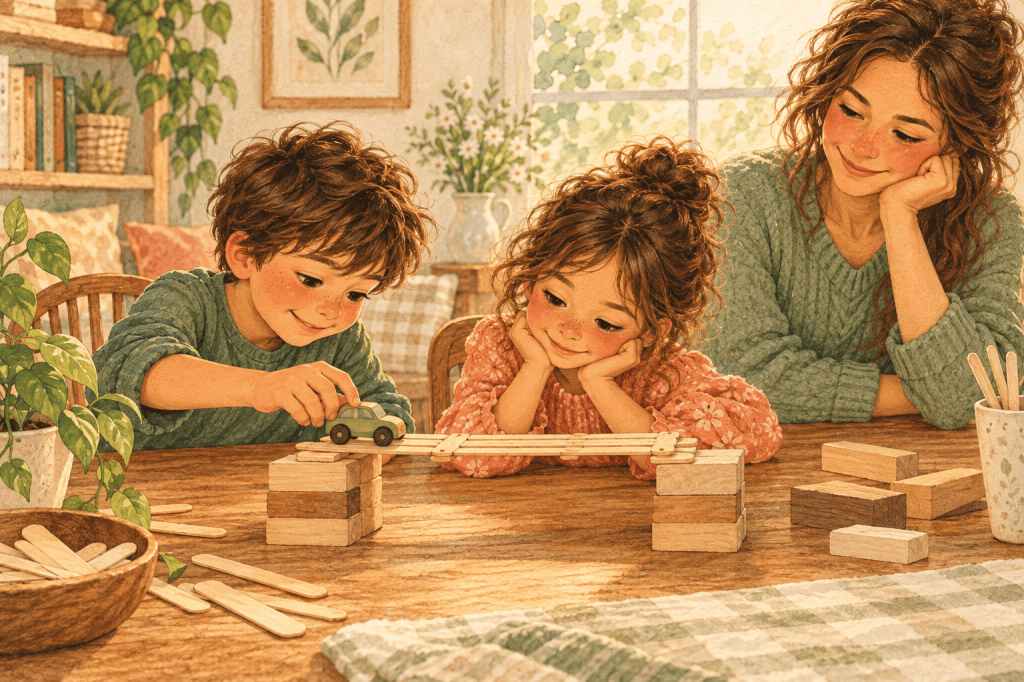
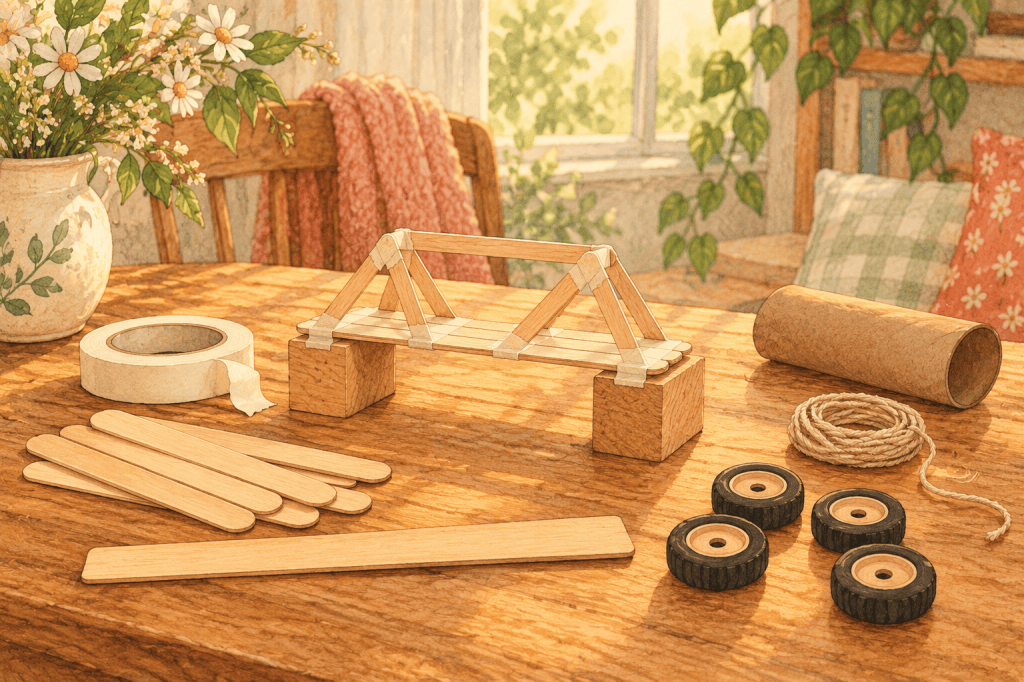
Place two stacks of books or blocks a short distance apart. Offer craft sticks, cardboard strips, paper, and tape. Ask the child to build a bridge that spans the gap and holds a toy car or several coins. Test one weight at a time.
If the bridge bends, avoid immediately supplying the solution. Ask what the child notices about the weak point. They might add layers, shorten the gap, change the supports, or redesign the surface.
Create a ramp investigation
Lean cardboard against a stack of books and roll a toy car down the ramp. Change one variable at a time: height, surface material, car, or distance. Measure with blocks, footsteps, or a simple ruler. Children can predict before each test and record results with marks or drawings.
Try a paper tower challenge
Give children several sheets of paper and a short length of tape. How tall can they build? Can the tower stand for thirty seconds? Can it hold a small object? Folding, rolling, and widening the base introduce structural ideas through direct experience.
Make a simple sink-or-float investigation
Gather a small set of safe objects made from different materials. Predict, test, and sort. Then look for patterns. Size alone does not determine whether something floats, so surprising results create useful questions.
Water activities require close adult supervision and immediate cleanup of spills. Use a shallow container and keep electronic items away.
Ask questions that reveal thinking
- What do you predict, and what makes you think that?
- What changed between the first test and the second?
- Where did the structure begin to fail?
- What could we keep the same next time?
- Can you explain your design to someone who did not see you build it?
Let failed designs remain useful
When the goal is genuine investigation, a design that collapses provides information. Model this language: “That version showed us the middle needs more support.” Children learn persistence when adults treat revision as a normal part of creating—not a penalty for getting it wrong.
Match the documentation to the child
A young child can draw before and after. Another child can photograph each version, make a tally, record measurements, or write one sentence about what changed. Documentation should help the child notice patterns, not overwhelm the activity.
Try one small step
Choose one idea that feels realistic, try it more than once, and watch what the child does with it. Useful learning experiences do not need to look impressive. They need enough time, safety, and flexibility for children to participate in their own way.
Sources & Further Reading
Find Pencil & Pebble
Etsy Store · Coming soon | Teachers Pay Teachers Store · Coming soon | YouTube · Coming soon | Instagram · Coming soon | Pinterest · Coming soon

