
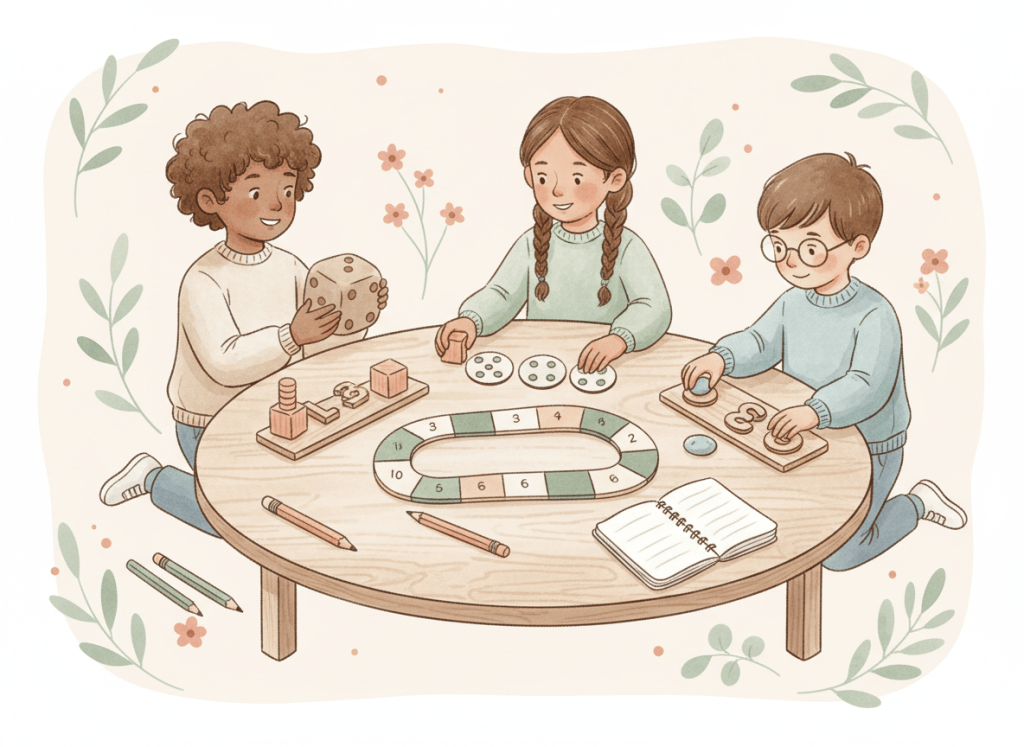
Math practice does not have to begin with a worksheet. It can begin with a pair of dice, a handful of buttons, a deck of cards, a block tower, or the question, “How many do you think are hiding?”
For young children, playful math gives abstract ideas something they can see, touch, move, compare, and talk about. A game can ask a child to count accurately, recognize a quantity, compare numbers, notice a pattern, make a plan, and explain a strategy—without making the experience feel like a miniature test.
That makes math games useful in classrooms, homeschool settings, after-school programs, and ordinary family life. The key is not buying a shelf full of “educational” games. It is choosing simple play that has a clear mathematical idea underneath it.
Why math games are more than a fun extra
The U.S. Department of Education’s What Works Clearinghouse recommends intentional, engaging mathematics instruction for young children and specifically includes games as one way to teach mathematical concepts and skills. It also recommends helping children see and describe mathematics in everyday routines.
NAEYC similarly highlights playful approaches to early mathematics. Dot-card games, number-path games, board games, building, puzzles, and everyday conversations can give children repeated opportunities to work with quantities, numerals, spatial relationships, patterns, measurement, and problem solving.
Games also make children’s thinking visible. If a child rolls five and moves a piece four spaces, an adult learns something. If the child immediately recognizes four dots without counting each one, that reveals something else. Instead of only checking whether an answer is correct, you can watch how the child approaches the problem.
The adult’s job: notice, nudge, then let the child think
It is tempting to turn a math game into rapid-fire questioning: “What number is that? What is five plus three? Which is bigger? Come on, you know this.” That can drain the playfulness quickly.
Try fewer, better questions. “How did you know?” “Can you make it another way?” “Which pile has more?” “What do you notice?” “What could you try next?” Then wait.
If a child is stuck, make the task smaller rather than immediately giving the answer. Use fewer objects, model one turn, or put the quantities side by side. The sweet spot is a game that requires thought but is still manageable enough that the child wants another turn.
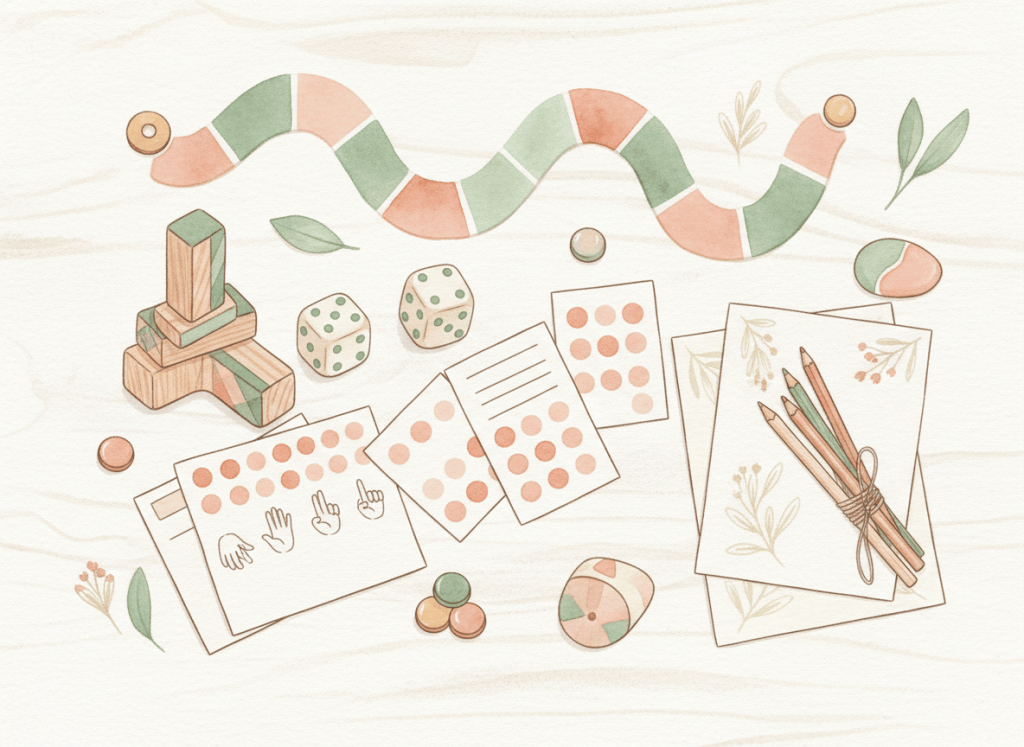
8 low-prep math games to try
1. Flash the dots. Make simple cards with one to ten dots in different arrangements. Show a card briefly and ask, “How many did you see?” For small quantities, children may begin recognizing the amount without counting one dot at a time—a skill called subitizing. Ask how they saw it: “I saw three and two” is rich mathematical thinking.
Start with one to three dots for children who are new to the game. Later, vary the arrangements rather than always placing dots in a familiar dice pattern.
2. Build my number. Say or show a number and invite the child to represent it with blocks, counters, fingers, toy animals, or small household objects. Then ask for another way. Five might become five blocks, two fingers plus three fingers, or a group of four buttons and one more.
This helps children connect a spoken number, a written numeral, and an actual quantity rather than treating “5” as an isolated symbol.
3. Roll and compare. Each player rolls one die. Compare the results: who has more, who has less, or are they equal? When that is easy, roll two dice and compare totals. Children can use counters if they need to build each amount.
For an older child, change the goal: roll two dice and choose whether to add, subtract, or multiply them. The winner is not necessarily the person with the highest number; you can set a target and see who gets closest.
4. Make a number path. Draw a path of connected spaces and number them in order. Players roll a die and move a small object along the path, counting one space for each move. NAEYC notes that number-path games can support numeral recognition, counting order, one-to-one correspondence, magnitude, and vocabulary such as before, after, more, and less.
Keep the path short for beginners. Extend it when counting each move becomes comfortable.
5. What’s hiding? Put a small number of counters on the table—say six. Let the child see all six, then cover some with a cup or your hand while leaving the rest visible. Ask, “How many are hiding?” Uncover them to check.
Younger children can start with totals of three or four. Older children can use larger totals or explain the equation that matches what happened.
6. Shape hunt. Choose a shape and search the room, yard, or classroom for examples. Instead of stopping at naming the shape, compare examples. Is every four-sided object a square? Which rectangles are long and narrow? Can you find a triangle pointing in a different direction?
For older elementary learners, hunt for parallel lines, right angles, symmetry, or examples of fractions in everyday objects.
7. Build, predict, measure. Use blocks, craft sticks, connecting cubes, or recycled boxes to build a tower or bridge. Before measuring, make a prediction: “How many cubes tall do you think it is?” Measure using the same unit and compare the estimate with the result.
Then change one thing. Make the tower wider, shorter, or twice as tall. Building naturally creates opportunities to talk about length, height, shape, position, comparison, and problem solving.
8. Card number battle. Remove face cards from a regular deck. Each player flips a card; compare the numbers. For children ready for more, each player flips two cards and adds them. Older children can multiply, subtract the smaller from the larger, create two-digit numbers, or try to get closest to a target.
One deck can therefore grow with a child for years.
Use the same game at different skill levels
A good math game does not need to be replaced every time a child learns something new. Often you can change one rule.
Imagine a simple dice game. A preschooler rolls one die, names the amount, and counts out that many counters. A kindergartner rolls two dice and decides which shows more. A first grader adds the two quantities. A second grader tries to make ten. An older child rolls several dice and creates an equation that reaches a target.
This is especially helpful for families or classrooms with mixed ages. Everyone can use the same materials while working at an appropriate level.
Bring math into ordinary routines
Games are wonderful, but mathematics is already hiding throughout the day.
At snack time, compare quantities or divide food evenly. While setting the table, ask how many forks are still needed. On a walk, look for repeating patterns or estimate how many steps it will take to reach a landmark. While cooking, notice measuring cups, fractions, time, temperature, and sequence. While cleaning up toys, sort by type, size, color, or another rule the child invents.
The What Works Clearinghouse encourages adults to help young children recognize and talk about mathematics in everyday situations. That does not require turning dinner into a lesson. A quick observation—“We need two more plates”—can be enough to make the mathematics visible.
What to do when a child gets frustrated
A math game stops being useful when the challenge is so high that the child spends the whole time feeling defeated. Frustration is information. Adjust the game rather than treating difficulty as a lack of effort.
Reduce the number range. Use physical objects. Let the child play on a team with you. Remove a rule. Model your own thinking aloud: “I don’t know yet. I see five and two, so I’m going to count on from five: six, seven.”
Also be thoughtful about winning. Some children love competition; others think much more clearly when everyone works toward a shared goal. Turn “Who gets the most?” into “Can we collect twenty together?” when cooperation makes the experience better.
And make room for mistakes. A wrong move is an opportunity to recount, rearrange, compare, and try again. The aim is not instant speed. It is increasingly flexible mathematical thinking.
How to tell whether the play is actually helping
You do not need a formal assessment after every game. Watch for small changes.
Does the child count objects more accurately? Do they recognize familiar dot patterns more quickly? Can they explain why one amount is greater? Are they beginning to count on instead of restarting at one? Do they notice shapes, quantities, measurements, or patterns without being prompted? Are they trying a second strategy when the first one does not work?
Those observations can guide the next version of the game. If a child easily recognizes quantities to five, try six through ten. If a number path to ten has become automatic, extend it. If addition with dice is comfortable, introduce a target-number challenge.
Start with what you already have
You can build a surprisingly rich math shelf from ordinary materials: dice, playing cards, paper, crayons, blocks, buttons or counters, a ruler, and a few small game pieces. Even fingers are powerful math tools.
Choose one game that matches what a child is currently learning and play it for five or ten minutes. Repeat it on another day. Change one rule when it becomes easy. Let the child invent a variation, too.
When children experience math as something they can touch, test, discuss, and play with, practice becomes more than a page of answers. It becomes a way of making sense of the world—and that is a habit worth building.
Sources & Further Reading
- U.S. Department of Education, What Works Clearinghouse: The Gateway to Math Success
- What Works Clearinghouse: Preparing Young Children for School
- NAEYC: Play Games, Learn Math! Dot Card and Finger Games
- NAEYC: Play Games, Learn Math! Number Path Games
- NAEYC: Fun, Easy Ways to Play with Math at Home
Find Pencil & Pebble
Etsy Store — coming soon here
Teachers Pay Teachers Store — coming soon here
YouTube — coming soon
Instagram — coming soon
Pinterest — coming soon

