
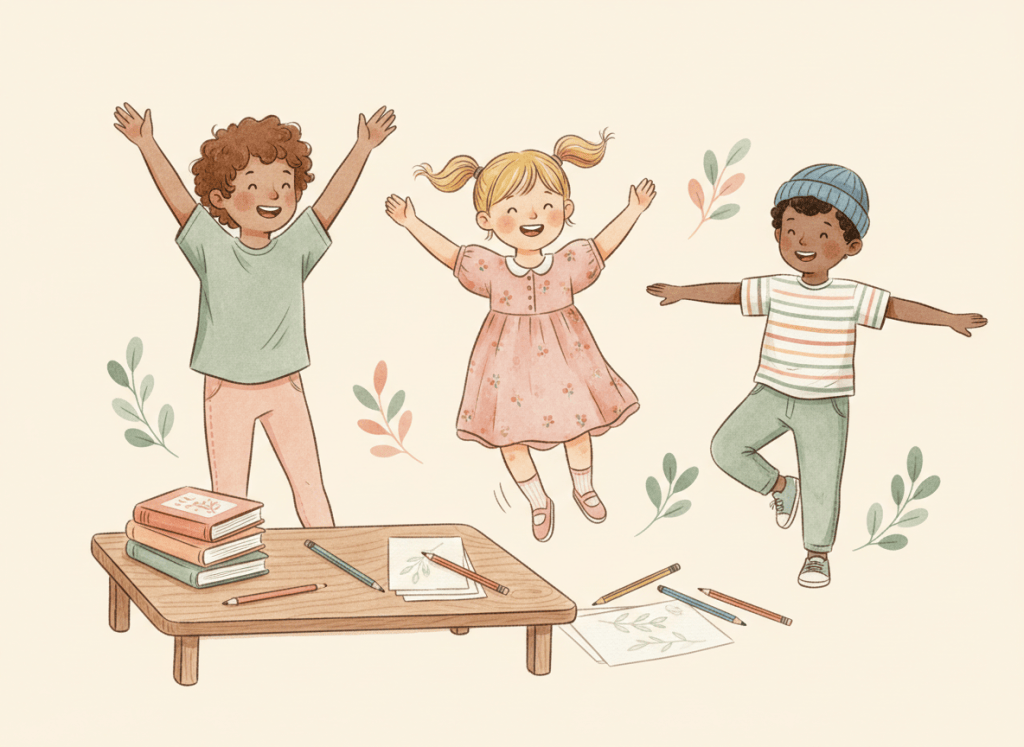
When a child starts sliding down in a chair, tapping a pencil, staring past the page, or turning a five-minute assignment into a twenty-minute negotiation, the instinct is often to push through. Sometimes the more useful choice is the opposite: get up and move.
Short movement breaks can fit naturally into a classroom, homeschool day, homework session, or tutoring block. They do not need special equipment, a workout video, or a complicated routine. A few intentional minutes of stretching, marching, balancing, or playful movement can give children a clear transition before they return to learning.
The goal is not to turn every lesson into gym class. It is to recognize that children are not designed to stay still for long stretches—and that movement can be part of a thoughtful learning environment.
Why movement belongs in the learning day
The CDC defines classroom physical activity broadly: it can be physical activity integrated into instruction or a break from instruction specifically for movement. The agency notes that classroom physical activity can support concentration, time on task, motivation, engagement, behavior, and academic performance.
That does not mean a two-minute stretch replaces recess, physical education, outdoor play, or a child’s overall activity needs. Children ages 6–17 are recommended to get at least 60 minutes of moderate-to-vigorous physical activity each day, while children ages 3–5 should be active throughout the day. A quick learning break is one small piece of that larger picture.
Movement can also be especially useful when a child is working hard to regulate attention. CDC guidance for supporting students with ADHD includes allowing breaks and time to move or exercise, while emphasizing that supports should be matched to the individual child. Even without a diagnosis, that last point matters: one child may return from jumping energized and ready; another may do better with slow stretching or a quiet walk.
Think “reset,” not “reward”
Movement works best when it is treated as a normal part of the day rather than something children must earn by sitting perfectly still. If movement is only offered after frustration has boiled over, children may begin to associate breaks with being in trouble—or adults may wait too long to use them.
Instead, build movement into predictable transition points. Try one after a demanding lesson, between two subjects, before writing, after independent reading, or when returning from lunch. At home, a child might move after finishing one homework subject before opening the next.
A predictable rhythm also removes some negotiation. “Math, movement, reading” is easier to understand than an uncertain promise that a break might happen later.
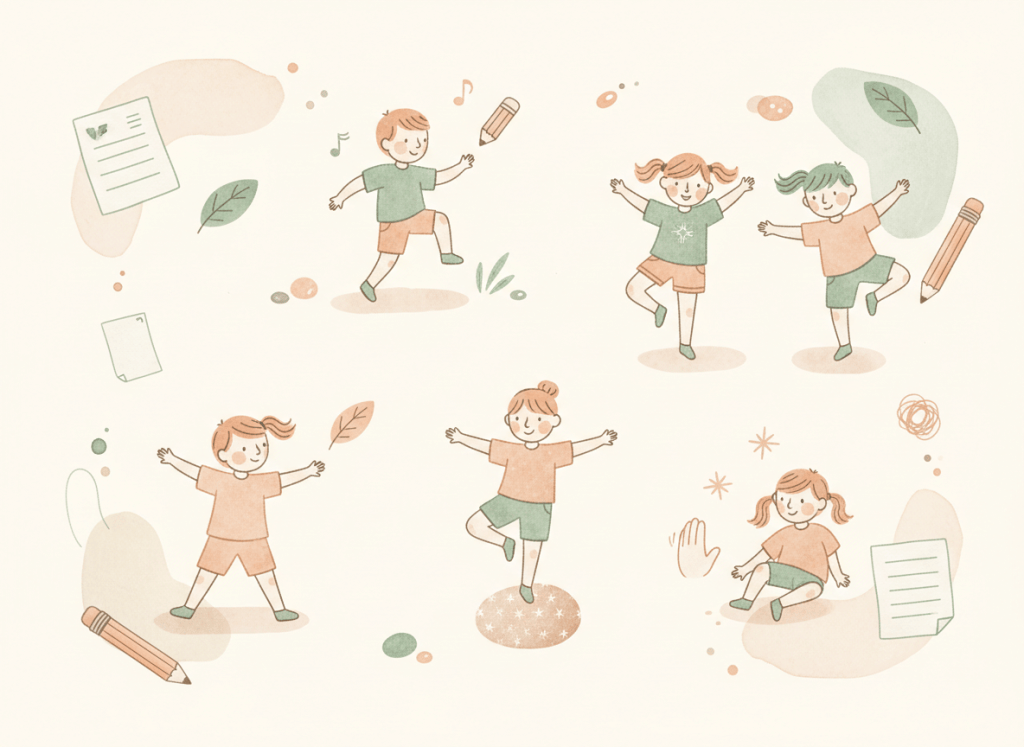
12 movement breaks that need almost no setup
1. Reach high, reach low. Stretch toward the ceiling, fold gently toward the floor, reach to each side, then roll the shoulders. This is a good low-key option when you want a reset without dramatically raising the room’s energy.
2. March and count. March in place for 30–60 seconds. Younger learners can count steps; older children can count by twos, fives, or tens. Keep the academic piece light—the point is still to move.
3. Invisible jump rope. Pretend to turn a jump rope and make small jumps. Children who should not jump can mimic the arm motion and alternate heel raises instead.
4. Balance challenge. Stand on one foot, switch sides, then try a different arm position. Make it playful rather than competitive. A chair or wall can provide support.
5. Freeze dance. Play a short piece of music and pause it several times. When the sound stops, everyone freezes. Harvard’s Center on the Developing Child includes games such as freeze dance among activities that can challenge attention and inhibitory control for young children.
6. Animal moves. Cross a small space like a bear, crab, frog, penguin, or very slow turtle. This works especially well with younger elementary children.
7. Wall push. Place both hands on a wall and gently push for several seconds, relax, and repeat. It is quiet, requires little space, and avoids turning the room into a racecourse.
8. Four-corner walk. Choose four safe points around the room and walk to each one. Change the direction, pace, or movement each round.
9. Copy me. One person performs three simple movements—perhaps clap, squat, reach—and everyone copies the sequence. Add another movement when the group is ready.
10. Red Light, Green Light. In a safe open space, children move on “green” and stop on “red.” For an extra challenge, change the movement or reverse a familiar rule once children understand the game.
11. Shake and settle. Shake hands, arms, shoulders, and legs for a few seconds, then stand still and take a slow breath. Repeat once or twice.
12. One-song walk. Walk around the room, hallway, yard, or safe outdoor space for the length of one short song, then come back to the next task.
Match the break to what the child needs next
Not every movement break should be high-energy. Before choosing one, ask a simple question: What do we need after this?
If the room feels sluggish, a brisk march, dance, or jumping activity may help create energy. If children are already loud and revved up, choose stretching, balancing, slow animal walks, or a quiet lap around the room. Before handwriting or a detailed task, a calmer break may make the transition easier than an exciting game.
Watch the child rather than the clock. If a break consistently makes returning to work harder, change the type of movement, shorten it, or create a clearer ending cue. A strategy is only useful when it works for the learner in front of you.
Make returning to work part of the routine
The break itself is only half of the routine. Children also need a clear path back.
Use the same ending signal each time: a timer, a short phrase, a chime, or the end of a song. Then make the next step obvious. Instead of “Okay, get back to work,” try “Break is finished. Open your notebook to the page we marked and do number one.”
For younger children, show the sequence visually: work → move → work. For older children, let them help choose from a small menu of breaks and set the timer themselves. The routine becomes increasingly independent as they learn what helps them reset.
Movement breaks for different ages
Preschool and kindergarten: Keep directions simple, playful, and brief. Animal walks, follow-the-leader, freeze games, and action songs work well. Children in this age range need plenty of activity across the entire day, not just scheduled breaks.
Early elementary: Give children a few choices. Try balance challenges, marching patterns, short dance breaks, or games that require listening and stopping. This age group often enjoys a little imagination without needing an elaborate story.
Upper elementary: Avoid making movement feel babyish. A short walk, stretching sequence, wall push, simple fitness challenge, or choice of music can feel more age-appropriate.
Mixed-age homeschool groups: Choose movements everyone can scale. One child can march while another jogs in place; one can balance with support while another tries a harder pose. The shared routine matters more than everyone doing an identical movement.
Keep movement accessible and pressure-free
A movement break should not embarrass a child or require an ability they do not have. Offer seated and standing versions when useful. Avoid elimination games, public rankings, or comments about athletic ability. Give children enough personal space and adapt activities for mobility, sensory, medical, or classroom needs.
Choice can help, too. “Would you rather stretch or walk?” preserves the purpose of the break while giving the child some control. For a child who dislikes group movement, carrying books to a shelf, delivering a note, watering a plant, or taking a quiet hallway walk may accomplish the same transition more comfortably.
A simple way to start tomorrow
You do not need twelve new activities on day one. Pick three: one energizing, one calming, and one that works in a tiny space. Decide on two predictable times to offer them. Keep each break short enough that returning to learning still feels easy.
Then observe. Does the child come back more ready to participate? Is the transition smoother? Does one kind of movement work better before reading and another before math? Those observations are more valuable than trying to follow a perfect schedule.
Movement is not wasted learning time. Used thoughtfully, it can be part of the structure that helps children participate in learning. Sometimes the most productive next step really is to stand up, wiggle, stretch, and begin again.
Sources & Further Reading
- CDC: Classroom Physical Activity
- CDC: Child Activity — An Overview
- CDC: ADHD in the Classroom
- Harvard Center on the Developing Child: Activities Guide for Executive Function Skills
Find Pencil & Pebble
Etsy Store — coming soon here
Teachers Pay Teachers Store — coming soon here
YouTube — coming soon
Instagram — coming soon
Pinterest — coming soon

