
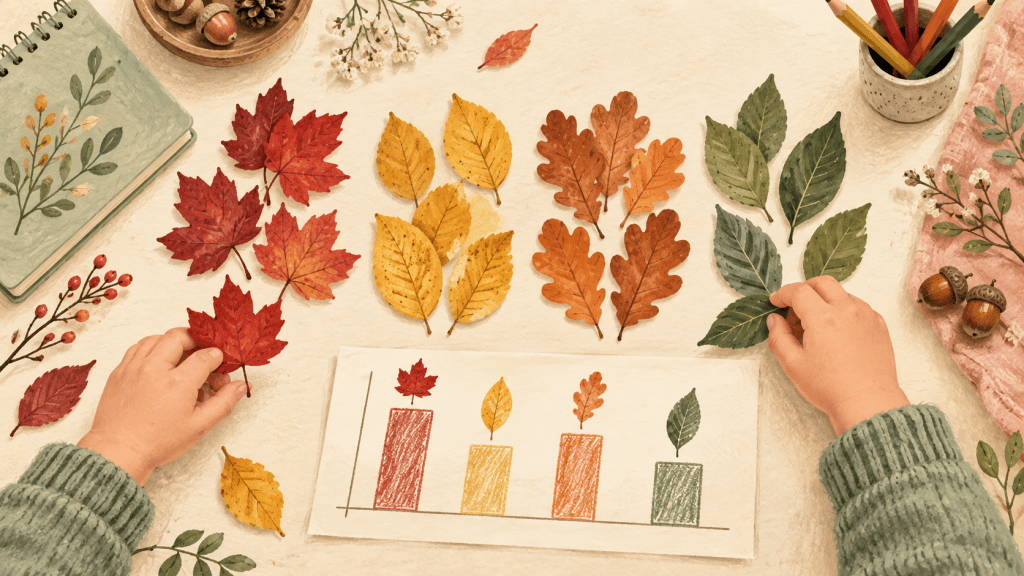
Turn a handful of autumn leaves into meaningful early math through sorting, counting, patterns, comparison, measurement, and child-made graphs. This is not about adding a complicated project to an already full day. It is about using a clear purpose, a few ordinary materials, and enough flexibility to notice what the learner needs.
By Paige Turner
A leaf collection becomes real mathematics when children make decisions, explain categories, and revise ideas instead of merely completing a themed page. The most productive version will look slightly different across homes and classrooms. Age, language, attention, prior experience, space, and available time all matter. Use the ideas below as a framework, then simplify freely.
Why this approach works
Children learn more from active decisions than from simply following a decorated set of directions. Useful learning asks them to compare, remember, communicate, test an idea, or adjust a plan. Those mental actions matter more than whether the final page or setup looks polished.
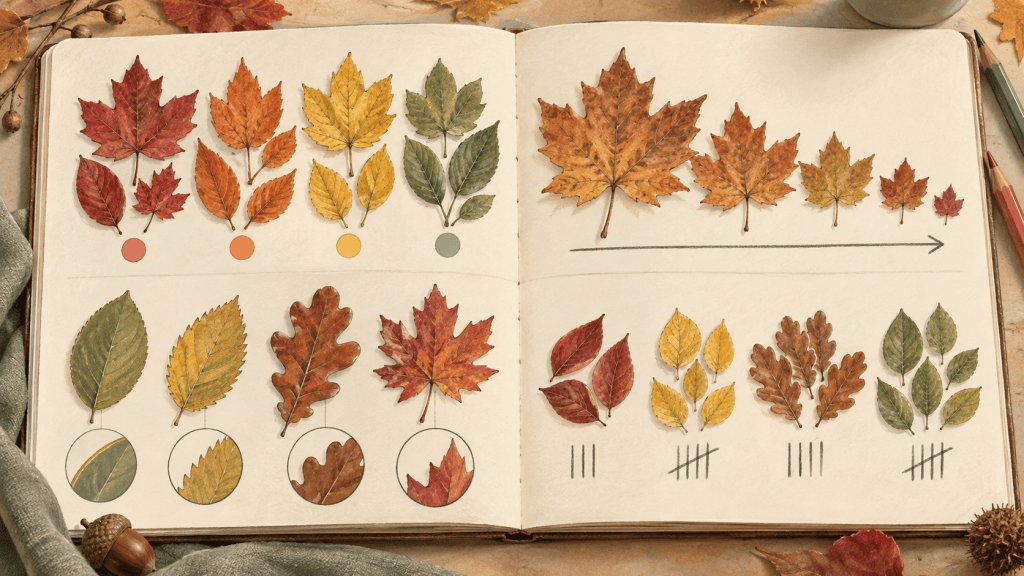
The adult role is equally important. We can prepare the environment, model a strategy, and provide language without controlling every move. When a child hesitates, wait long enough to see whether they are planning. When a child makes an error, make space for noticing before supplying the answer. Support should make the next bit possible while leaving meaningful thinking with the learner.
This approach also makes differentiation more natural. Younger children can point, match, move, or tell. Older children can record, justify, compare methods, or design a variation. A child who finds writing difficult can explain orally. A child who needs more challenge can create a rule, teach the activity, or test an exception.
What you need
Fallen leaves or paper leaves; tray; crayons; paper; string; small counters. Keep the setup intentionally modest. Too many materials can turn an invitation into a management problem. Start with the smallest workable set and add something only when it opens a new kind of thinking.
A practical way to begin
1. Notice before naming
Begin small and make the expectation visible. A leaf collection becomes real mathematics when children make decisions, explain categories, and revise ideas instead of merely completing a themed page. For this step, explain what you are trying, demonstrate only as much as needed, and then give the child time to respond. Watch what the child actually does before adding another prompt. If the step creates confusion, reduce the number of materials or choices and try again. The goal is useful participation, not a picture-perfect result.
A practical check is to ask, “What would make this easier to begin next time?” The answer may be a clearer location, a shorter direction, an example, a different tool, or simply more practice. Treat that information as part of the activity rather than evidence that it failed.
2. Invite one sorting rule
Begin small and make the expectation visible. A leaf collection becomes real mathematics when children make decisions, explain categories, and revise ideas instead of merely completing a themed page. For this step, explain what you are trying, demonstrate only as much as needed, and then give the child time to respond. Watch what the child actually does before adding another prompt. If the step creates confusion, reduce the number of materials or choices and try again. The goal is useful participation, not a picture-perfect result.
A practical check is to ask, “What would make this easier to begin next time?” The answer may be a clearer location, a shorter direction, an example, a different tool, or simply more practice. Treat that information as part of the activity rather than evidence that it failed.
3. Count with one-to-one touch
Begin small and make the expectation visible. A leaf collection becomes real mathematics when children make decisions, explain categories, and revise ideas instead of merely completing a themed page. For this step, explain what you are trying, demonstrate only as much as needed, and then give the child time to respond. Watch what the child actually does before adding another prompt. If the step creates confusion, reduce the number of materials or choices and try again. The goal is useful participation, not a picture-perfect result.
A practical check is to ask, “What would make this easier to begin next time?” The answer may be a clearer location, a shorter direction, an example, a different tool, or simply more practice. Treat that information as part of the activity rather than evidence that it failed.
4. Compare groups
Begin small and make the expectation visible. A leaf collection becomes real mathematics when children make decisions, explain categories, and revise ideas instead of merely completing a themed page. For this step, explain what you are trying, demonstrate only as much as needed, and then give the child time to respond. Watch what the child actually does before adding another prompt. If the step creates confusion, reduce the number of materials or choices and try again. The goal is useful participation, not a picture-perfect result.
A practical check is to ask, “What would make this easier to begin next time?” The answer may be a clearer location, a shorter direction, an example, a different tool, or simply more practice. Treat that information as part of the activity rather than evidence that it failed.
5. Build and repair patterns
Begin small and make the expectation visible. A leaf collection becomes real mathematics when children make decisions, explain categories, and revise ideas instead of merely completing a themed page. For this step, explain what you are trying, demonstrate only as much as needed, and then give the child time to respond. Watch what the child actually does before adding another prompt. If the step creates confusion, reduce the number of materials or choices and try again. The goal is useful participation, not a picture-perfect result.
A practical check is to ask, “What would make this easier to begin next time?” The answer may be a clearer location, a shorter direction, an example, a different tool, or simply more practice. Treat that information as part of the activity rather than evidence that it failed.
6. Measure with informal units
Begin small and make the expectation visible. A leaf collection becomes real mathematics when children make decisions, explain categories, and revise ideas instead of merely completing a themed page. For this step, explain what you are trying, demonstrate only as much as needed, and then give the child time to respond. Watch what the child actually does before adding another prompt. If the step creates confusion, reduce the number of materials or choices and try again. The goal is useful participation, not a picture-perfect result.
A practical check is to ask, “What would make this easier to begin next time?” The answer may be a clearer location, a shorter direction, an example, a different tool, or simply more practice. Treat that information as part of the activity rather than evidence that it failed.
7. Create a floor graph
Begin small and make the expectation visible. A leaf collection becomes real mathematics when children make decisions, explain categories, and revise ideas instead of merely completing a themed page. For this step, explain what you are trying, demonstrate only as much as needed, and then give the child time to respond. Watch what the child actually does before adding another prompt. If the step creates confusion, reduce the number of materials or choices and try again. The goal is useful participation, not a picture-perfect result.
A practical check is to ask, “What would make this easier to begin next time?” The answer may be a clearer location, a shorter direction, an example, a different tool, or simply more practice. Treat that information as part of the activity rather than evidence that it failed.
8. Ask the child to explain a new rule
Begin small and make the expectation visible. A leaf collection becomes real mathematics when children make decisions, explain categories, and revise ideas instead of merely completing a themed page. For this step, explain what you are trying, demonstrate only as much as needed, and then give the child time to respond. Watch what the child actually does before adding another prompt. If the step creates confusion, reduce the number of materials or choices and try again. The goal is useful participation, not a picture-perfect result.
A practical check is to ask, “What would make this easier to begin next time?” The answer may be a clearer location, a shorter direction, an example, a different tool, or simply more practice. Treat that information as part of the activity rather than evidence that it failed.
Concrete ways to adapt it
Red versus yellow. Try this as a brief invitation rather than a test. Ask the child to notice, predict, choose, or explain. If the response is unexpected, stay curious: ask how they decided and what they might try next.
Smooth versus jagged edges. Try this as a brief invitation rather than a test. Ask the child to notice, predict, choose, or explain. If the response is unexpected, stay curious: ask how they decided and what they might try next.
Shorter than a crayon. Try this as a brief invitation rather than a test. Ask the child to notice, predict, choose, or explain. If the response is unexpected, stay curious: ask how they decided and what they might try next.
Repeating red-yellow-yellow patterns. Try this as a brief invitation rather than a test. Ask the child to notice, predict, choose, or explain. If the response is unexpected, stay curious: ask how they decided and what they might try next.
For a preschooler or early elementary learner, shorten the activity and make the action visible. For an older elementary learner, ask for a comparison, explanation, written note, or redesigned version. In a classroom, let partners take different roles and switch. At home, stop while interest is still present; returning tomorrow is often more valuable than stretching an activity past its useful life.
What to notice
Children practice classification, cardinality, comparison language, pattern reasoning, measurement, data representation, and mathematical explanation. Look for strategies as well as correct answers. Does the child organize materials before starting? Do they use a reference? Can they explain a choice? Do they change course after new information? These observations tell you more about the next helpful step than a score alone.
Progress may first appear as easier starting, longer engagement, clearer language, or greater willingness to retry. Those changes count. Avoid turning every enjoyable experience into an assessment, but keep a brief mental or written note when a pattern will help you plan.
Common snags and gentle fixes
The child does not want to begin. Reduce the entry demand. Offer one material, one example, or two genuine choices. Participation may begin with watching.
The adult is doing most of the thinking. Replace a stream of directions with one useful question, then wait. Try: “What do you notice?” “How could we check?” or “What is one thing you could change?”
The activity ends very quickly. That may be enough. If the child is still interested, invite a new rule or role instead of piling on more of the same.
The result is different from the plan. Return to the learning purpose. If the child practiced the intended thinking in another way, the activity may have succeeded.
It becomes frustrating. Pause before frustration becomes the main lesson. Preserve the work, name where you stopped, and decide together whether to simplify, get support, or return later.
Keep the ending simple
A useful closing question is, “What would you remember or do differently next time?” The child can answer with words, a gesture, a quick sketch, or a demonstration. Then put away only what needs to be put away. A calm ending helps children remember the experience as something they can return to.
A leaf collection becomes real mathematics when children make decisions, explain categories, and revise ideas instead of merely completing a themed page. When adults protect that purpose and allow the activity to stay flexible, children get something more durable than a finished page: a strategy, a connection, or a new way to notice the world.
Sources & Further Reading
Find Pencil & Pebble
- Etsy Store — non-clickable placeholder; destination URL pending verification
- Teachers Pay Teachers Store — non-clickable placeholder; destination URL pending verification
- YouTube — non-clickable placeholder; destination URL pending verification
- Instagram — non-clickable placeholder; destination URL pending verification
- Pinterest — non-clickable placeholder; destination URL pending verification

