

A family day trip can hold an enormous amount of learning without becoming a lesson plan. Children read signs, ask questions, compare environments, navigate maps, estimate time, observe people and animals, encounter unfamiliar vocabulary, and connect ideas to real places.
By Paige Turner
The trick is protecting the outing itself. When adults try to capture every educational possibility, curiosity can turn into another assignment. Choose one light intention, leave room for wandering, and let the child’s attention guide part of the day.
Choose places with something real to notice
Learning-rich outings do not have to be expensive. Try a public library, farmers market, botanical garden, nature trail, local museum, historic neighborhood, fire-station open house, community festival, shoreline, transit ride, or public-art walk. Even an unfamiliar grocery store can invite comparison of foods, languages, packaging, prices, and geography.
Prepare just enough
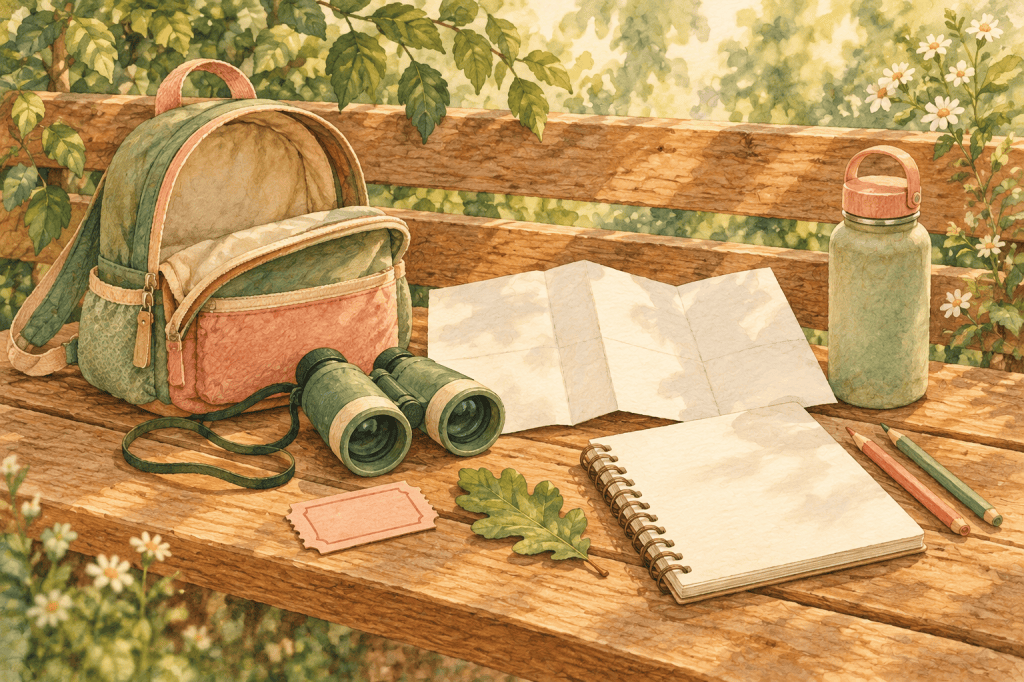
Share where you are going, what the child can expect, and one or two basic rules. Look at a map or a few photographs beforehand if unfamiliar settings are stressful. Pack water, a snack, weather-appropriate clothing, and any sensory or mobility supports the family normally uses.
Avoid explaining everything before arrival. Leave discoveries available for the actual trip.
Give each child a small job
- Carry the map or help choose the next stop.
- Look for one object connected to a current interest.
- Take three photos that tell the story of the outing.
- Sketch one surprising detail.
- Keep track of the family’s reusable water bottles.
- Choose one question to investigate later.
Use questions sparingly
A child staring at an aquarium tank does not need a quiz about every fish. Try observations that open conversation: “That one keeps returning to the same corner,” or “The roots are much larger than I expected.” When the child asks a question, wonder together before looking for the answer.
Follow the unexpected interest
You may visit a science museum for dinosaurs and discover the child only wants to study the elevators. That does not mean the trip failed. Elevators involve engineering, safety systems, measurement, design, and cause and effect. Learning often begins where attention already lives.
Build literacy naturally
Invite children to read a map label, exhibit heading, menu, trail marker, timetable, or short plaque when it serves a real purpose. Adults can read longer text aloud. New vocabulary is easier to understand when the object, place, or event is directly in front of the child.
Add simple math and planning
Estimate travel time, compare ticket options, count stops, notice shapes in buildings, divide a shared snack, read a schedule, or choose how to spend a small souvenir budget. Keep the math connected to a genuine decision rather than inventing problems throughout the day.
Leave space for sensory breaks
Museums, markets, and events can be loud, crowded, visually busy, and physically tiring. Identify a quieter bench, outdoor space, or predictable break point. A shorter successful visit can build more confidence than staying until everyone is depleted because the family paid for admission.
Capture the memory afterward
On the way home, ask each person to share one thing they noticed—not what they learned. Later, the child might draw a favorite moment, label photographs, add a ticket to a scrapbook, rebuild something with blocks, find a related library book, or dictate a short family caption.
Seven low-cost outing ideas
- Choose a new library branch and explore its children’s area.
- Take a color-and-texture walk through a local park.
- Visit a farmers market and select one unfamiliar fruit or vegetable.
- Ride public transportation to a familiar destination.
- Explore public murals or architecture downtown.
- Attend a free museum or community education day.
- Pack sketchbooks and observe one place for fifteen quiet minutes.
Keep connection at the center
The best outcome may be a new fact, a strong question, a shared joke, or simply a child remembering that their family explored somewhere together. Learning does not have to be extracted from every moment. It often grows naturally when children feel safe enough to notice.
Start smaller than you think
Choose one part of the routine to make clearer this week. Keep the language simple, make the next action visible, and give the child time to practice before adding more responsibility. Sustainable independence is built through many manageable repetitions.
Sources & Further Reading
Find Pencil & Pebble
Etsy Store · Coming soon | Teachers Pay Teachers Store · Coming soon | YouTube · Coming soon | Instagram · Coming soon | Pinterest · Coming soon

