
By Paige Turner
Handwriting practice often becomes a negotiation about how many lines are left. A child who can explain an imaginative idea may shut down when asked to copy a paragraph. Another may form letters accurately but so slowly that writing consumes all available attention.
The answer is not to abandon handwriting or fill more pages. Children need explicit practice with letter formation and frequent chances to use handwriting for real purposes. The useful middle ground is short, focused, and meaningful.
Separate the Skills Inside “Writing”
Handwriting is only one part of written expression. A child may be managing ideas, vocabulary, spelling, punctuation, spacing, letter formation, pencil pressure, and remembering the sentence at the same time.
Decide what matters in a given task. During letter practice, formation and movement are the focus. During story composition, the child might dictate while an adult writes, then handwrite one chosen sentence. During spelling practice, provide enough space and time that letter production does not hide what the child knows.
Reducing simultaneous demands is not removing rigor. It lets the intended skill receive attention.
Check the Setup Before Correcting the Page
A few physical changes can make writing easier:
- feet supported rather than dangling;
- table and chair at a comfortable height;
- paper angled slightly to match the writing hand;
- the nonwriting hand holding the page;
- a sharp pencil that moves smoothly;
- enough light; and
- short work periods before fatigue changes the grip.
Children do not all need the same pencil. Try a standard pencil, shorter pencil, triangular barrel, mechanical pencil, or felt-tip pen. A grip aid may help some learners, but it should not be forced if it creates discomfort.
If writing routinely causes pain, extreme fatigue, or significant distress, discuss the pattern with the child’s teacher, pediatrician, or an appropriate occupational therapy professional rather than treating it as a motivation problem.
Teach Formation in Small Groups
Letters are easier to remember when grouped by similar movements. The exact grouping varies by handwriting program, but the principle is consistent: practice a few related formations instead of moving randomly through the alphabet.
For example, work with letters that begin with a similar curve or downward stroke. Use clear language for where the movement starts and how it travels. Model slowly, then let the child trace once, copy once with a model, and write once from memory.
Aim for a handful of careful repetitions. Twenty rushed letters can rehearse an inefficient pattern. Stop while attention and movement are still controlled.
Use Meaningful Micro-Writing
After direct formation practice, use the target letters in a real task. Keep it short enough that the child can care about legibility.
Try:
- label three objects in a drawing;
- write one item on the grocery list;
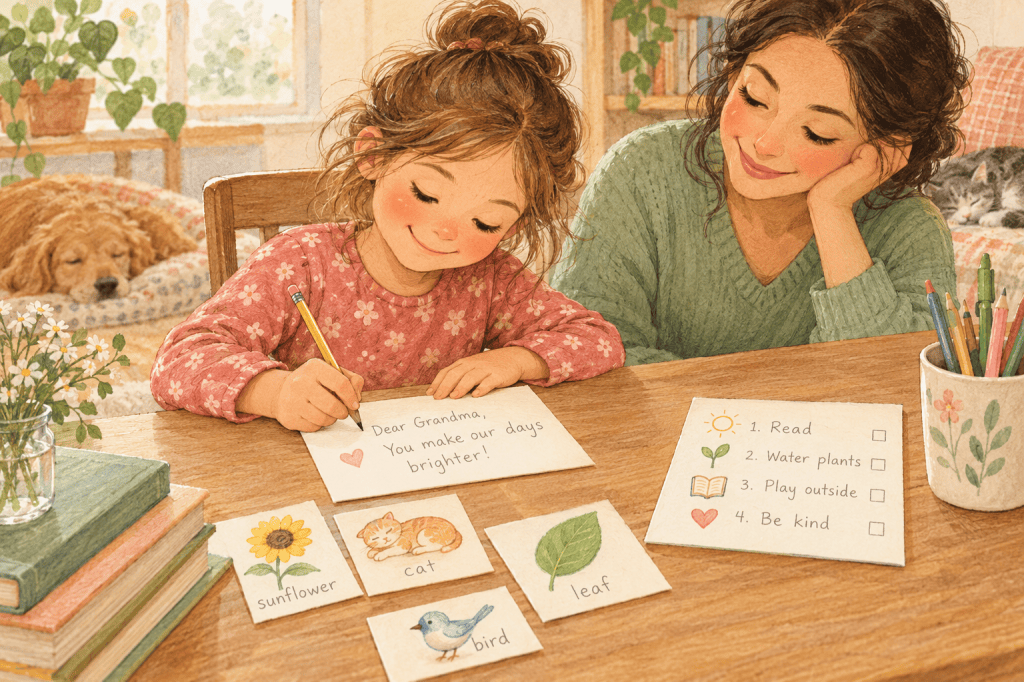
- leave a note for a family member;
- make a two-step plan for a game;
- caption a photograph;
- write a pet-care reminder;
- add a name and date to artwork;
- create one clue for a scavenger hunt; or
- copy a favorite short line selected by the child.
Meaning does not replace instruction, but it gives the movement a reason. Children begin to experience handwriting as a tool for communicating, not merely a pattern to reproduce.
Keep Copying Purposeful
Copywork can support attention to spelling, punctuation, and fluent letter sequences when the passage is short and readable. It becomes less useful when the child loses the sentence while trying to reproduce a distant model.
Place the model close to the writing area. Use one sentence at first. Let the child mark natural chunks with a light slash, look at a chunk, cover it, and write it from memory. Then compare the result.
Ask the child to choose one thing to improve on a second attempt: spacing, one letter, staying on the line, or punctuation. Do not circle every imperfection. A page covered in corrections does not tell a developing writer what to do next.
Build Fluency Without a Race
Fluency means producing legible writing with increasing ease. Timed work can provide information, but public races and pressure often damage quality.
Use a private one-minute sample occasionally. Ask the child to copy a familiar, short sentence comfortably. Count only legible letters, save the sample, and compare it with the child’s own later work. Do not compare siblings or classmates.
An even gentler measure is stamina: “How much comfortable writing can you do before your hand needs a break?” Gradually increase by one sentence or one minute when the child is ready.
Give Feedback the Hand Can Use
“Write neater” is too broad. Choose one visible, actionable point:
- start this letter at the top;
- leave a finger space here;
- keep the tall letters reaching the same line;
- slow down for this curve; or
- lift the pencil between these two letters.
Begin by identifying what is working. Then model the selected change and ask for one or two attempts. End with the strongest example circled by the child.
If many features are difficult, select the one that most affects readability or comfort. Other features can wait.
Support Left-Handed Writers
Angle the paper so the top points slightly to the right, and position it a little left of the child’s midline. Encourage the hand to stay below the writing line when comfortable so the child can see what is being written. Place models where the writing hand does not cover them.
Avoid forcing a child to switch hands. Hand preference develops naturally, and support should be adapted to the writer.
A Ten-Minute Practice Plan
- One minute: loosen hands with gentle finger movements.
- Two minutes: model one formation pattern.
- Three minutes: trace, copy, and write a few target letters or words.
- Three minutes: use them in a note, label, list, or caption.
- One minute: choose the clearest example and name one success.
Practice three or four times a week is more useful than a long, exhausting session. End before frustration overwhelms the movement you want the child to remember.
Protect the Child’s Ideas
When children compose, let ideas lead. Offer dictation, speech-to-text, shared writing, or an adult scribe for longer pieces. Then select a manageable portion for handwriting. This prevents a developing transcription skill from shrinking the child’s language and imagination.
Use Samples to Notice Growth
Save one dated sample every few weeks rather than every practice page. Choose comparable tasks, such as the same short sentence plus one original sentence. Look together for changes in readability, spacing, ease, and stamina.
Ask the child what feels easier. The most meaningful growth may be less hand fatigue, remembering where to start a letter, or being able to hold a sentence in mind while writing. These changes may appear before the page looks dramatically different.
If progress stalls, change one condition at a time. Reduce the amount, enlarge the writing space, move the model closer, or return to direct formation practice. More repetition is not always the answer when the current setup is rehearsing discomfort.
Handwriting deserves instruction, and children deserve dignity while learning it. A short note written with purpose can teach more than a full page completed through resistance. Over time, clear models, comfortable tools, useful feedback, and repeated real writing help the hand catch up with the ideas waiting behind it.
Sources & Further Reading
- Institute of Education Sciences: Teaching Elementary School Students to Be Effective Writers
- Institute of Education Sciences: Teaching Elementary School Students to Be Effective Writers
- International Literacy Association

