
By Paige Turner
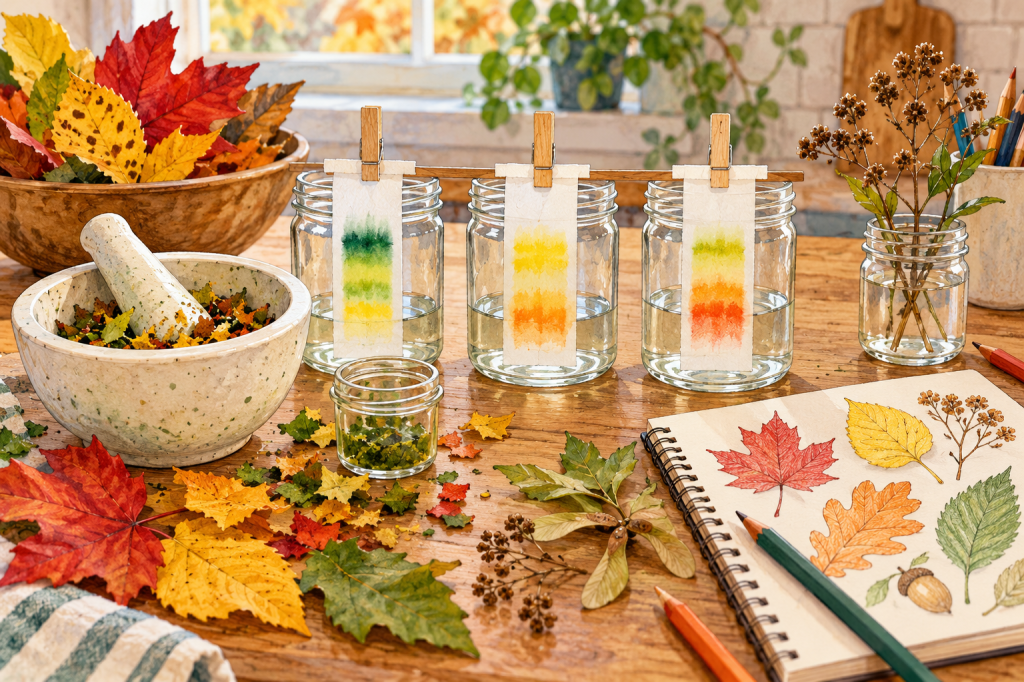
Fall leaves appear to change from green to yellow, orange, red, and brown. Some of those colors were present earlier but masked by abundant chlorophyll. Paper chromatography can help separate pigments from crushed leaves, producing colored bands that invite children to look more closely at what a leaf contains.
This activity uses rubbing alcohol and therefore requires active adult handling, ventilation, and careful storage. Children can collect, sort, predict, observe, draw, and measure. An adult should pour and manage the alcohol and keep it away from heat, flames, mouths, and eyes.
Gather Materials
- several freshly fallen leaves in different colors;
- small glass jars or sturdy clear cups;
- rubbing alcohol;
- scissors for adult use;
- a spoon or other tool for crushing leaves;
- white coffee filters or chromatography paper;
- pencils or craft sticks;
- tape or clothespins;
- plastic wrap or jar lids; and
- notebook, ruler, and colored pencils.
Use one jar per leaf type or color. Label the setup outside the jar rather than writing on the paper strip.
Prepare the Leaf Samples
Sort leaves by type and color. Do not mix every leaf into one jar if the goal is comparison. Tear or cut each sample into very small pieces and place it in the corresponding jar. Crush the pieces firmly to break plant tissue.
An adult adds just enough rubbing alcohol to cover the crushed material, then covers the jar. Place the jars in a shallow container of warm water to help pigments move into the alcohol. The water should be warm, not boiling, and no heat source should be near the alcohol.
Wait until the liquid becomes colored. This may take 30 minutes or longer. While waiting, children can sketch each original leaf and predict which pigment bands may appear.
Prepare the Paper Strips
Cut long strips from a white coffee filter. A strip should fit into the jar without touching the sides. The bottom should reach the colored liquid, while most of the strip remains above it.
Attach the top of the strip to a pencil or craft stick laid across the jar. Only the very bottom edge should touch the liquid. Keep the leaf pieces below the strip if possible.
As the liquid travels upward through the paper, it carries pigments at different rates. Over time, colored areas may separate. Results vary by leaf, pigment concentration, paper, and setup. Some bands will be faint. Science activities do not owe us a dramatic result.
Observe Before Naming
Ask children to record what is visible at several points:
- How high has the liquid moved?
- Which color appears first?
- Are the bands sharp, blended, dark, or faint?
- How many color regions can you distinguish?
- Does the strip show colors that were not obvious on the leaf?
When the liquid nears the top, remove the strip and let it dry in a safe, ventilated area. Mark the highest point reached by the liquid before it evaporates if you plan to measure.
Explain the Basic Science
Chromatography separates parts of a mixture because those parts interact differently with the moving liquid and the paper. The alcohol is the mobile phase; the paper is the stationary phase. Pigments that dissolve and travel more readily may move farther, while others remain closer to the starting point.
Leaves contain pigments including chlorophylls and carotenoids. The visible result depends on which pigments are present and how well the procedure extracts and separates them. Red or purple pigments may behave differently from green and yellow pigments, and brown tissue may not produce bright bands.
Keep the explanation connected to the evidence. Children do not need to memorize pigment names to notice that a seemingly single leaf color can contain a mixture.
Turn It Into a Comparison
Use one variable at a time.
Compare colors from the same tree
Test a green leaf and a yellow leaf from the same type of tree. What bands appear in both? Which are stronger?
Compare different trees
Choose similarly colored leaves from two species. Do their strips look identical?
Compare fresh and dry leaves
Use the same type of leaf in different conditions. Record differences in extraction and band clarity.
Compare predictions with results
Before opening the jars, children choose colored pencils to predict the band sequence. Afterward, they draw the actual strip beside the prediction.
Avoid changing the paper, amount of leaf, alcohol level, and warming method at the same time. When many conditions change, it is difficult to explain why results differ.
Adapt by Age
Younger children
Focus on sorting, color matching, watching liquid move, and drawing before-and-after strips. Adults complete every chemical-handling step.
Grades 1 and 2
Count visible bands, compare lengths using cubes or a ruler, and use words such as higher, lower, darker, and lighter.
Grades 3 through 5
Create a table of samples, predictions, visible bands, and distance traveled. Write a claim such as “The yellow leaf and green leaf shared a yellow band,” then cite the strips as evidence.
If the Experiment Looks “Wrong”
Faint results are information. Common causes include too little pigment, pieces that were not crushed enough, too much alcohol, paper dipping too deeply, or insufficient time.
Ask children what they would change in a second trial. Make one adjustment and document it. That revision is more scientifically valuable than quietly replacing the strip with a prettier result.
Safe Cleanup
The adult should remove and dispose of remaining alcohol according to the product label and local household guidance. Keep it away from drains if local instructions advise against disposal there. Seal or discard leaf material, wash tools thoroughly, wipe the workspace, and have everyone wash hands.
Do not use experiment containers for food unless they can be thoroughly cleaned and are appropriate for reuse. Store rubbing alcohol immediately out of children’s reach.
Extend the Investigation
- Photograph each strip beside its original leaf.
- Arrange strips from least to most colors.
- Make a class chart showing shared pigments.
- Research why chlorophyll decreases as daylight and temperature change.
- Create watercolor art inspired by the bands, keeping art materials separate from experiment tools.
Create a Clear Lab Record
Give each sample its own row in a table. Include leaf description, collection place, prediction, extraction color, number of visible bands, and distance traveled. Attach or photograph the dry strip beside the row. Do not rely on memory after several samples are complete.
Older children can measure from the starting line to the center of each visible band. The measurements do not need to become advanced calculations; their purpose is to make comparisons more precise. If two observers disagree about where one color ends, record that the boundary was blended. Scientific records can include uncertainty.
Invite children to write a claim that stays within the evidence: “The green maple sample showed green and yellow regions” is stronger than “All green leaves contain exactly two pigments.” Discuss how many samples would be needed before making a broader statement.
Connect the Bands to Seasonal Change
As days shorten and conditions change, many deciduous plants produce less chlorophyll. Other pigments can become more visible as green fades. Weather, tree species, leaf health, and pigment chemistry all affect fall color, so not every tree changes at the same time or in the same way.
Return to trees rather than treating the strip as the entire lesson. Compare the chromatography record with photographs of the source tree. Ask what the experiment suggests, what it cannot show, and what additional observations would help.
The best ending question is not “Did yours work?” Ask, “What does your strip show, and what would you try next?” Children learn that evidence can be subtle, variable, and still worth examining.
Sources & Further Reading
- American Chemical Society: Celebrating Chemistry
- Science Buddies: Leaf Chromatography
- National Library of Medicine: Paper Chromatography—A Review

