
By Paige Turner
A number line is more than a row of numbers. It is a model of magnitude, distance, order, and change. Children can use it to count, compare, add, subtract, locate unknown numbers, reason about place value, and eventually understand fractions and negative numbers.
One fixed 0–20 strip cannot support all of that work. A useful toolkit includes several formats and movable pieces so the representation can change as the child’s thinking grows.
Include Four Core Number Lines
A labeled 0–20 line
Use evenly spaced tick marks, clear numerals, and arrows that suggest the line continues. This supports counting on and back, comparing numbers, and early addition and subtraction.
A labeled 0–100 line
Label tens clearly while keeping smaller tick marks visible. Depending on the learner, include all numerals or only the decade numbers. This line supports relative size, skip counting, rounding, and two-digit operations.
An open number line
Provide a long blank line with arrows but no fixed ticks. Students add only the numbers and jumps needed for a problem. This keeps attention on relationships rather than counting every printed mark.
A blank partitioned line
Use a line with endpoints and optional equal sections. Children can label missing numbers, locate fractions, or decide how intervals should be divided.
Print each format separately. Crowding all four onto one page makes the toolkit harder to use.
Add Movable Pieces
Include simple markers:
- arrows;
- dots or circles;
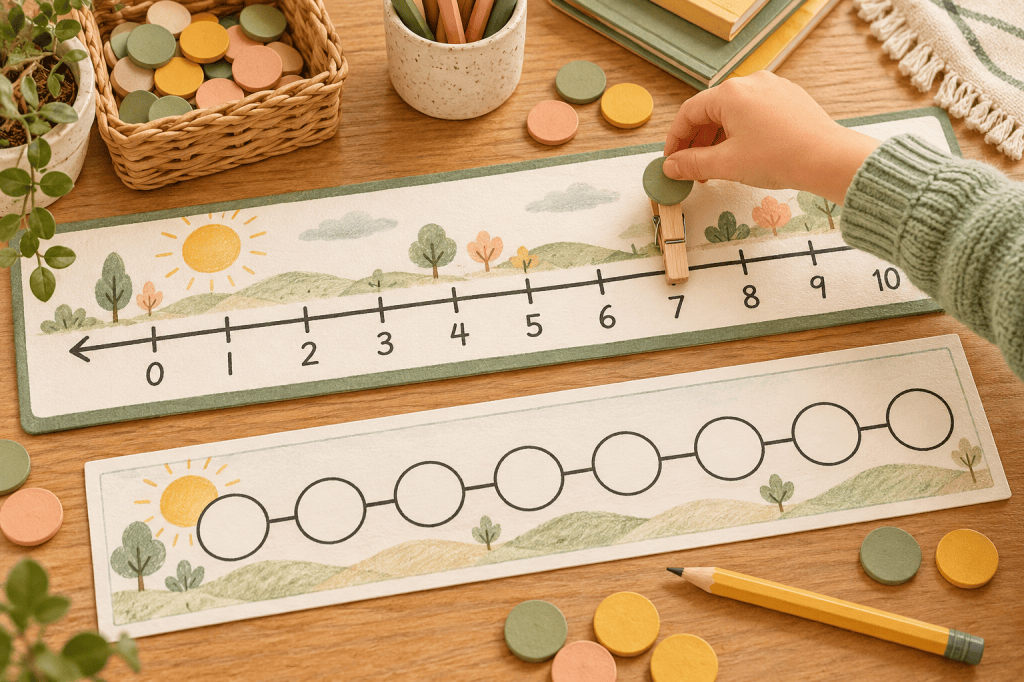
- clothespin labels;
- small number cards;
- operation cards; and
- blank write-in tags.
Children can move a marker before writing. This reduces the motor and working-memory load and makes thinking visible. Laminate only if it serves your setting; paper strips in reusable sleeves may be easier to store and recycle.
Teach What the Line Represents
Before using jumps, establish that equal spaces represent equal differences. On a 0–10 line, the distance from 2 to 3 must match the distance from 8 to 9. The numerals label positions; they are not decorative boxes.
Ask children to place a few benchmark numbers:
- Where does 5 belong between 0 and 10?
- Where might 8 go?
- Is 6 closer to 5 or 10?
On an open line, placement does not need to be perfectly to scale, but direction and relative size should make sense.
Use the Toolkit for Addition
For 7 + 5, place a marker at 7 and make a jump of 5 to the right. Then show a more strategic version: jump 3 to reach 10 and 2 more to reach 12. Ask how the two paths represent the same total movement.
The line should support reasoning, not become a rule that every child must use for every problem. Some students may prefer decomposing with place-value blocks or known facts. Compare representations and discuss when each is useful.
Use It for Subtraction in Two Ways
Subtraction can mean taking away or finding a difference.
For 14 − 6, start at 14 and move 6 left. To find the difference between 8 and 14, start at 8 and count up to 14. Both paths produce 6, but they tell different stories.
Ask:
- Where did you start, and why?
- Which direction did you move?
- What does the jump mean?
- Could you break it into friendlier jumps?
Language connects the physical movement to the operation.
Explore Missing Numbers
Cover selected labels or use a blank line with endpoints. Avoid sequences where every answer is obvious from the first few directions. Vary the missing positions and intervals.
Examples:
- endpoints 0 and 20 with a midpoint to label;
- 35 at one point and 45 at another, with equal ticks between;
- a line showing 60, one blank tick, and 80;
- a point halfway between 100 and 200; or
- a mystery number closer to 40 than 50.
Require a reason: “I know this point is 70 because the spaces are equal and it is halfway between 60 and 80.”
Connect to Place Value
Use the 0–100 line to show that adding ten creates a larger jump than adding one. Compare 34 + 20 with 34 + 2. On an open line, students can record tens jumps above the line and ones jumps below it.
For rounding, mark benchmark tens and ask which endpoint is closer. Do not teach “five rounds up” as an isolated chant before children understand the midpoint and distance.
Prepare for Fractions
A fraction number line emphasizes that fractions are numbers with positions and distances. Begin with 0 and 1. Fold or partition the line into equal parts. Label one-half, then fourths, thirds, or eighths.
Compare two lines of equal length partitioned differently. Ask why one-half lands at the same location on both. Later, extend beyond 1 so children can locate improper fractions and mixed numbers.
The equal spacing matters more than decorative fraction pictures. A number line makes the size of each fraction visible.
Design Pages Children Can Actually Use
- Keep tick marks dark and consistent.
- Leave writing room above and below the line.
- Use arrows at both ends when continuation matters.
- Avoid decorative elements that look like data points.
- Provide color and low-ink versions.
- Print floor lines in sections with clear join marks.
- Include a short adult guide with example questions.
Do not put the explanation only at the bottom of a busy student page. A child-facing page should say what to do near the work area in direct language.
A Week of Number-Line Practice
- Day 1: place and compare benchmark numbers.
- Day 2: model addition with one jump and decomposed jumps.
- Day 3: model subtraction as taking away and difference.
- Day 4: solve missing-number and interval puzzles.
- Day 5: choose one problem and explain why the line helps.
Keep sessions short. The goal is not to complete every printable but to make the representation familiar enough that children can choose it independently.
Watch for Common Misunderstandings
A child may count tick marks instead of spaces, begin a jump at zero rather than the starting number, or make unequal intervals. These errors reveal how the model is being interpreted.
Use a finger or movable marker and narrate one example slowly. Ask the child to explain what each position and space means. Then remove the adult language gradually.
Let Children Choose When to Use It
After the model is familiar, place number lines with other math tools rather than handing one out automatically. Ask, “Would a number line, counters, drawing, or place-value model help?” Choice reveals whether the child understands the tool’s purpose.
During a brief conference, compare two solutions to the same problem. One may use a number line and another may decompose numbers mentally. Discuss what each representation makes easy to see. A number line is especially helpful for distance, order, and change; it may be less efficient for a fact the child already knows fluently.
Store the pieces in labeled envelopes by range and format. Include a dry-erase sleeve, a few markers, and one small adult prompt card. A toolkit that can be found and reset quickly is more likely to become part of everyday problem solving.
A well-designed number-line toolkit does not give children another trick to memorize. It gives them a place to show how numbers relate. As the labels become less complete and the ideas become more complex, the same simple line can continue carrying serious mathematical thinking.
Sources & Further Reading
- What Works Clearinghouse: Assisting Students Struggling with Mathematics
- What Works Clearinghouse: Developing Effective Fractions Instruction
- National Council of Teachers of Mathematics: Curriculum Focal Points

