
By Paige Turner
Weekly reflection can help children notice what they learned, which strategies helped, and what remains confusing. It can also help adults plan. But a reflection sheet stops being reflective when it asks children to perform enthusiasm, fill every line, or select a smiling face so the page looks complete.
A useful reflection makes honesty safe. It separates “this was difficult” from “I failed,” offers several ways to respond, and leads to an adult action when support is needed.
Keep the Page Short and Spacious
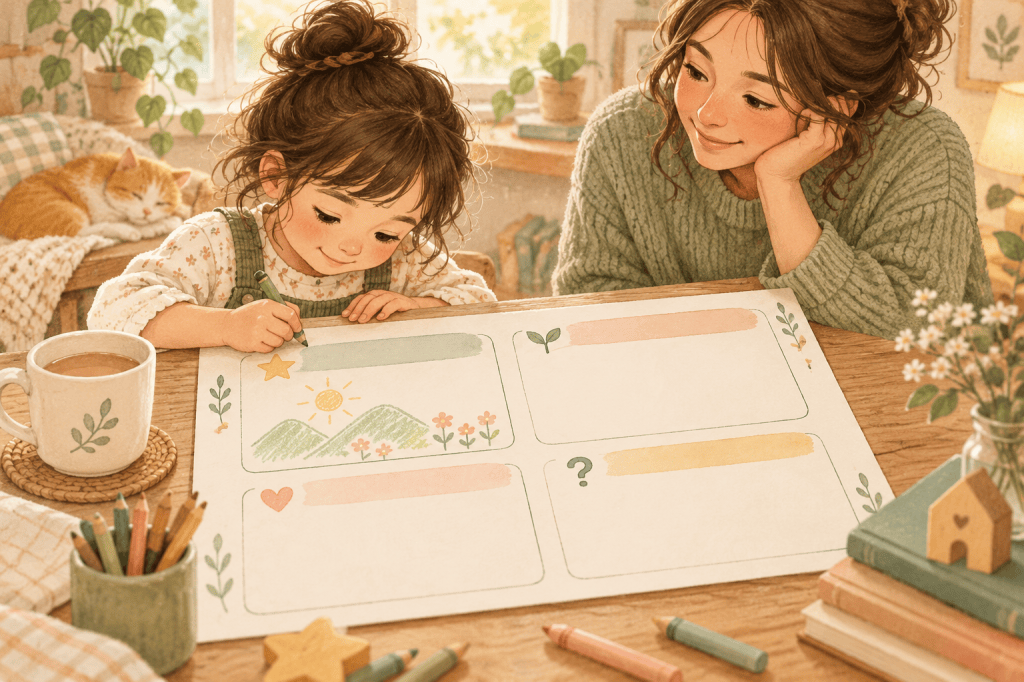
One page is enough. Use four large sections rather than a dozen prompts:
- Something I learned or can do now.
- Something that was challenging.
- A strategy or person that helped.
- Something I want to try or ask next.
Add a small space for a drawing, example, or work sample. Leave generous room. A child should be able to draw a math model or paste a tiny photograph, not squeeze an answer onto one narrow line.
Explain What Reflection Is
Children may assume the sheet is another test. Introduce it as a tool for looking back and planning forward.
Say: “This page helps us notice what changed this week. It is okay to write that something is still confusing. That tells us what support to plan.”
Share an adult example that is genuine but appropriate: “I learned how to organize the new materials. I still had trouble making cleanup quick. Next week I will label the bins.” This models specific reflection without turning it into a speech about attitude.
Ask Questions Children Can Actually Answer
Broad prompts such as “How was your week?” often produce “good.” Make prompts concrete:
- What can you do now that was harder on Monday?
- Which example are you proud of, and why?
- Where did you get stuck?
- What did you do after you got stuck?
- Which tool, model, book, classmate, or adult helped?
- What would you like explained another way?
- What should we practice less, more, or differently?
Rotate one optional question instead of printing all of them every week.
Offer Multiple Response Modes
Reflection is thinking, not a handwriting endurance test. Children may:
- write words or sentences;
- draw and label;
- circle from a small strategy list;
- dictate to an adult;
- record an audio response;
- choose a work sample and explain it orally; or
- use symbols and then discuss them.
If a child dictates, write the child’s words without polishing them into adult language. Read the response back and ask whether it says what the child meant.
Use Scales Carefully
Smiley faces can imply that happiness is the preferred answer. If a scale is useful, tie it to a specific experience:
- I can do this independently.
- I can do this with a reminder or model.
- I need more teaching and practice.
Another option is a support scale: “No help, one hint, worked together, or adult modeled.” These labels provide planning information without ranking the child’s worth or mood.
Avoid combining effort, behavior, mastery, and feelings into one rating. A child can work hard and still need instruction. A child can master a skill and dislike the activity.
Teach Strategy Vocabulary
“What strategy did you use?” is confusing if strategies have never been named. Build a small shared list from actual lessons:
- reread;
- draw a model;
- use a number line;
- say it aloud;
- break it into parts;
- look at an example;
- ask a question;
- take a short break;
- check with evidence; or
- try a different tool.
Add strategies as children use them. Let a child select “I am not sure” rather than choosing a random answer.
Respond So Honesty Remains Safe
If a child writes, “I learned nothing,” resist correcting the attitude. Ask a neutral follow-up: “Was the work already familiar, too confusing, or hard to remember?” The response may reveal boredom, missing instruction, fatigue, or difficulty retrieving examples.
If a child names a challenge, do something with that information. Write a brief adult response, adjust a task, schedule a check-in, or explain what will happen next. Reflection without response teaches children that the form is decorative.
Do not use vulnerable answers as public examples without permission. A child should know who will read the sheet and how it will be used.
Use Reflection in Classrooms
Set aside ten calm minutes, ideally before materials are packed away. Display examples of evidence children can reference: notebooks, reading books, projects, or photographs. Allow quiet thinking before discussion.
The teacher can sort reflections into planning groups:
- ready for extension;
- needs another example;
- needs vocabulary support;
- needs a different representation; or
- needs an individual conversation.
These categories are temporary instructional decisions, not labels placed on students.
Use Reflection at Home
Homeschool families can complete the page together at the end of the week. A parent may reflect too: “One thing I taught clearly” and “one thing I need to explain differently.” This keeps responsibility from resting entirely on the child.
For children attending school, do not make the page another required Friday assignment unless it is genuinely helpful. Use it occasionally after a project, difficult week, or period of noticeable growth.
Revisit Earlier Pages
Reflection becomes more powerful when children can see change over time. Once a month, review earlier sheets and ask:
- Did a former challenge become easier?
- Which strategies appear more than once?
- Are the questions changing?
- What kind of support helps most?
- What is one next goal based on the pattern?
Let the child choose a goal. Keep it specific and small: “Use a number line before asking for the answer” is more actionable than “get better at math.”
A Clean Printable Layout
Use readable type, strong contrast, and minimal decoration. Keep icons clearly separate from response boxes. Provide a low-ink version. Include the date and a place for the child’s name, but do not require a decorative title that consumes writing space.
An adult guide can explain purpose, response options, and follow-up questions. Keep those directions off the child page. The student should see a calm invitation, not a wall of instructions.
What a Good Reflection Produces
The page is successful when it produces useful information and a small next step. It does not need polished sentences or uniformly positive feelings. A thoughtful drawing, a circled strategy, and the words “I still don’t understand regrouping” may be more valuable than a paragraph written to please the adult.
Reflection teaches children that learning can be examined and adjusted. They are not simply people to whom lessons happen. They can notice what they know, identify what they need, and participate in deciding what comes next.
Sources & Further Reading
- Institute of Education Sciences: Teaching Elementary School Students to Be Effective Writers
- Center on the Developing Child: Executive Function Activities Guide
- National Center on Improving Literacy

